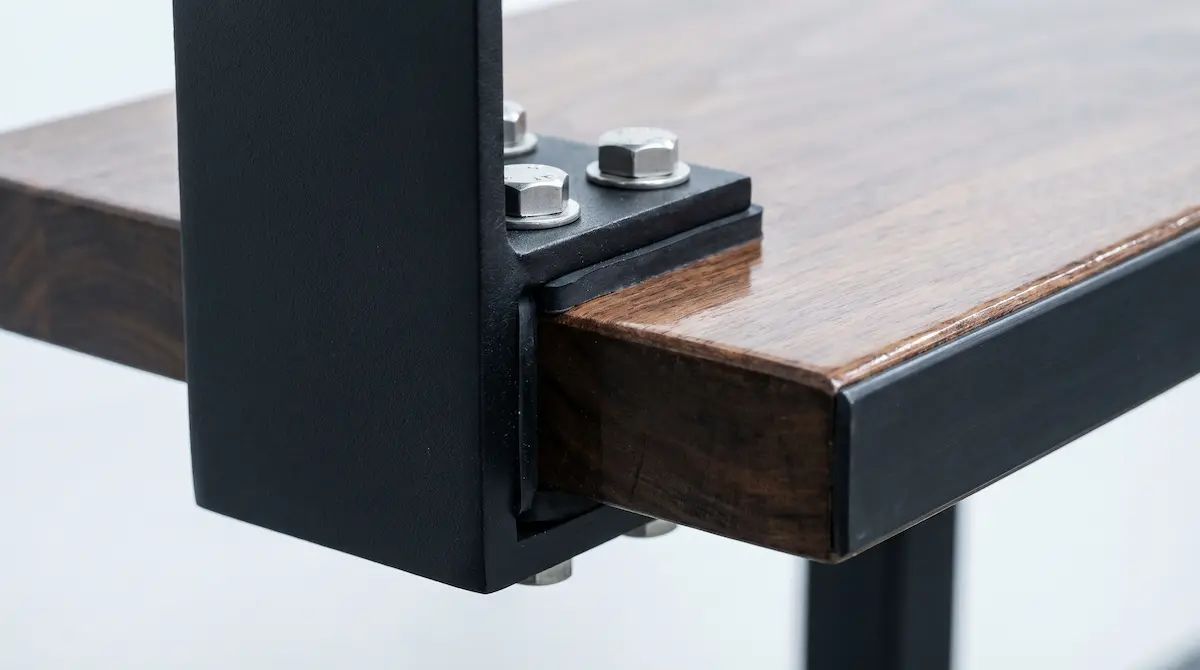
ASTM B117 neutral salt fog for 1,500 continuous hours with no red rust is the acceptance line most marine-zone hardware schedules are written to, and standard commercial hardware rarely reaches it. One number explains the gap: the Pitting Resistance Equivalent. Grade-304 sits near 18; Grade-316, carrying 2.0-3.0% molybdenum, sits above 25, so chloride needs different conditions to break through the passive film. Geothermal sites fail by another route entirely — hydrogen sulfide reacts with copper and iron to form black sulfides, and what stops it is coating film thickness rather than stainless grade. This article treats coastal, sulfur and high-humidity microclimates separately, because they do not call for the same specification.
If procurement specifications fail to allocate capital toward microclimate-specific defenses, deploying standard commercial-grade hardware and PVA cold glue edge banding leads to systemic failure within 3 to 6 months: drawer runners and hinges seize with rust, metal trims develop dark pitting corrosion, and casework back panels bloom with black mold and swell irreversibly. This causes high Out-of-Order (OOO) room downtime and forces complete FF&E replacement within 2 to 3 years.
Sunder integrates B2B Value Engineering (VE) and electrochemical corrosion defense, enforcing ISO 12944 marine-grade anti-corrosion standards and Grade-316 metallurgy to protect developer capital across extreme environments.
1. Micro-Mechanisms of Coastal Marine Pitting & Geothermal Sulfidation
In marine and geothermal microclimates, metal and casework degradation operate via distinct electrochemical pathways:
+-------------------------------------------------------------------------+
|        2 Extreme Microclimate Chemical Degradation Pathways             |
+-------------------------------------------------------------------------+
|  【Coastal Salt-Spray Environment (ISO 12944 C5 Marine Grade)】         |
|   Airborne Salt Mist ──► Chloride Ions (Cl⁻) penetrate passivation film |
|                          ──► Pitting Corrosion ➔ Structural Perforation |
|                                                                         |
|  【Geothermal Hot Spring Environment (High Atmospheric H2S Gas)】       |
|   Hydrogen Sulfide Gas ──► Reacts with copper/iron metal ions           |
|                            ──► Forms black brittle sulfides (CuS/FeS)   |
|                                ➔ Hardware seizure and fracture          |
|                                                                         |
|  【Subtropical Maritime Humidity (RH > 80%)】                           |
|   Unsealed Capillaries ──► Capillary suction draws vapor into timber    |
|                            ──► Core swells > 25% ➔ Fungal mold outbreak |
+-------------------------------------------------------------------------+
+-------------------------------------------------------------------------+
| Chloride Pitting Attack vs. Sunder Grade-316 Passivation Model |
+-------------------------------------------------------------------------+
| [Corrosive Atmospheric Media] Coastal Salt Mist (NaCl) / Sulfur (H2S) |
| │ |
| ├──► 【Standard 201 / Grade-304 Stainless (Low Molybdenum)】 |
| │ Zero/low Mo ──► Passive oxide layer breached by Cl⁻ ions |
| │ --> Pitting spots and red rust emerge within 3 months |
| │ |
| └──► 【Sunder Grade-316 Marine Stainless (2.5% Molybdenum Mo)】 |
| Dense self-healing passivation barrier ──► Blocks Cl⁻ ions |
| --> 10 Years mirror luster with zero pitting corrosion |
+-------------------------------------------------------------------------+2. Sunder 4-Tier Environmental Anti-Corrosion Hierarchy (ISO 12944)
Sunder establishes microclimate-targeted specifications, preventing budget overruns caused by unguided full-property over-specification:
+-------------------------------------------------------------------------+
|     Sunder 4-Tier Extreme Environment Material Armor (Cross-Section)    |
+-------------------------------------------------------------------------+
|  [Layer 1: Exterior Metal]   Grade-316 Austenitic Stainless Steel       |
|                              (Molybdenum Mo 2.5%, PREN >= 25)           |
|                                │                                        |
|  [Layer 2: Finish Armor]     Dual Electrophoretic Primer + PVDF Powder  |
|                              (Total Dry Film Thickness >= 120µm)        |
|                                │                                        |
|  [Layer 3: Sealed Core]      JIS F☆☆☆☆ Marine Hardwood Multi-Ply        |
|                              (6-Sided Vacuum Hydrophobic Seal, 8%-10%)  |
|                                │                                        |
|  [Layer 4: Edge Fusion]      German Reactive PUR Hot-Melt (-40°C~150°C) |
+-------------------------------------------------------------------------+
1. Coastal High-Chloride Zones: Grade-316 & Duplex 2205 Metallurgy
- All exposed hardware, balcony credenzas, and lobby metal trims within of the coastline utilize Grade-316 Austenitic Stainless Steel () or Duplex Stainless Steel 2205.
- Pitting Resistance Equivalent Number (vastly superior to standard Grade-304 with ), which is the threshold most marine-zone hardware schedules are written to.
2. Geothermal Sulfur Zones: Dual Electrophoresis + PVDF Fluorocarbon Armor
- In geothermal environments with active sulfur vapors, metal surfaces receive a dual-layer protective sequence: cathodic epoxy electro-coat () plus high-temperature thermoset fluorocarbon powder coating ().
- Combined film thickness reaches , putting a continuous physical barrier between the substrate and gas.
3. Casework Joinery: 6-Sided Vacuum Hydrophobic Sealing & PUR Edge Fusion
- All panel undersides, back faces, and pre-bored hardware holes receive nano-penetrating hydrophobic barrier sealants, achieving 100% 6-sided sealed envelope integrity.
- Edges are fused with German reactive Polyurethane (PUR) hot-melt adhesives, keeping water-absorption thickness swelling strictly .
3. ASTM Environmental Resistance & Salt Spray Compliance Matrix
Extreme Environment Engineering Quality Acceptance Matrix
| Inspection Vector | Testing Standard | Sunder Passing Spec |
|---|---|---|
| Salt Spray Corrosion | ASTM B117 (Continuous Fog) | 1,500 Hours Zero Rust |
| Sulfur Dioxide Gas | ISO 6988 Acid Gas Exposure | 20 Cycles No Blistering |
| Humidity Chamber | ASTM D2247 (50°C, 95% RH) | 1,000 Hours No Peeling |
| Boiling Water Boil | EN 314-2 Class 3 Marine | 72 Hours No Delamination |
| QUV Weathering | ASTM G154 (1,000 hrs UV) | Gloss >= 85%, ΔE <= 1.5 |
4. Value Engineering (VE): Targeted Capital Allocation
In extreme environments, applying maximum-spec materials uniformly across every room inflates initial CapEx. Sunder implements Microclimate Zoning Allocation:
Sunder Targeted Environmental Capital Allocation Matrix
| Spatial Zone | Microclimate Risk Level | Sunder Optimized Spec |
|---|---|---|
| Outdoor Balconies | Extreme (Direct Salt/Sun) | Grade-316 + PVDF Coat |
| Hot Spring Suites | High (Sulfur Gas + Steam) | Grade-316 + Full PUR |
| Enclosed Guestrooms | Medium (Subtropical Air) | Grade-304 E-Coat + E0 |
| Interior Corridors | Low (Continuous HVAC) | Standard Commercial Spec |
Confining Grade-316 to balconies and hot-spring suites usually keeps the metal cost increase in single digits as a percentage, while allowing those zones to be accepted at ASTM B117 1,500 hours with no red rust. Applying the same specification building-wide raises cost without a matching return in HVAC-controlled corridors.
5. Total Cost of Ownership (TCO): Standard FF&E vs. Sunder Marine-Grade Engineering
10-Year TCO Evaluation: Standard FF&E vs. Sunder Marine-Grade Spec
| Evaluation Vector | Standard Commercial Spec | Sunder Marine Spec |
|---|---|---|
| Hardware Corrosion Life | Seizes in 3 to 6 months | 10 Years Zero Rust |
| Casework Moisture Mold | Backs mold within 12 months | 10 Years Zero Mold |
| Sulfur Gas Resilience | Tarnishes and embrittles | 100% Sulfur Immune |
| FF&E Replacement Cycle | Every 2 to 3 Years (Scrap) | 10+ Year Asset Life |
| Corrosion OOO Room Loss | 8% ~ 12% Annual Downtime | 0% Room Downtime |
| 10-Year Cumulative TCO | Baseline (100% + 2 Scraps) | Reduced to 31% |
6. Conclusion: Engineering Science Overcoming Extreme Natural Elements
Behind the most breathtaking panoramic landscapes lies nature’s most corrosive chemistry. Chloride and hydrogen sulfide attack at rates the specification sets, and that specification is written zone by zone rather than building by building.
Sunder unites ISO 12944 marine-grade classifications, Grade-316 stainless metallurgy, and targeted microclimate budgeting. Two exclusions belong in the schedule. Grade-316 inside an HVAC-controlled corridor buys cost and nothing else. Chlorinated pool plant rooms and steam spas run higher chloride concentrations than coastal air, and Grade-316 can still pit there — Duplex 2205 or a non-metallic fitting is the correct call.