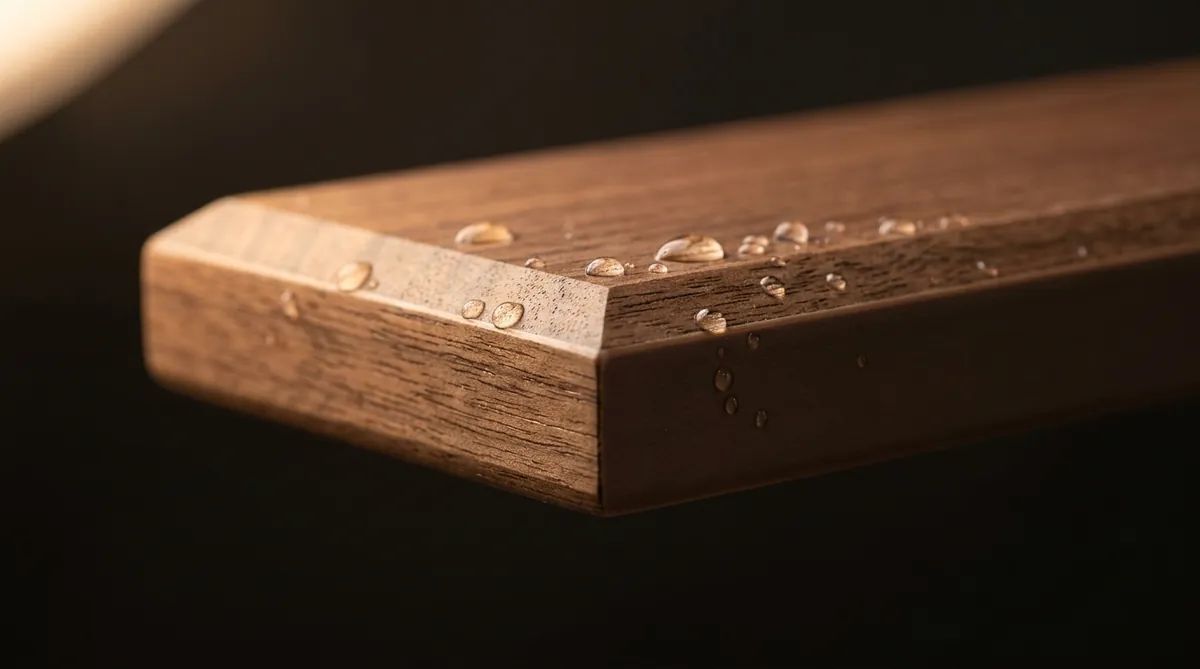
The equilibrium moisture content of a panel follows two variables and nothing else: relative humidity and temperature. Taiwan and the wider subtropical maritime belt run at RH 75% to 90% annually, with HVAC cycling rooms between 16°C and 32°C, so the same panel absorbs and releases moisture all year. Detailing written for dry temperate factories — EVA hot-melt edge banding, unsealed undersides, plated hardware — comes through the mock-up intact and parts company with the specification in Year 2 to Year 3: glue lines fissure, undersides absorb, plated fasteners go red. Coastal sites add a layer, because hardware has to hold chloride-bearing air for ten years while ASTM B117 reads its result at 120 hours; passing that test is not the same as passing the decade. Four lines in the schedule close it off, and they belong in the asset management case rather than the aesthetic one: edge-banding chemistry, underside treatment, floor clearance and hardware metallurgy.
During conventional B2B procurement strategies, developers frequently import residential-grade casegoods engineered for dry, temperate zones. When exposed to Taiwan’s monsoon seasons and intense HVAC thermal cycling (16°C ~ 32°C), conventional EVA hot-melt adhesives and unsealed underside panel faces suffer moisture ingress through micro-fissures. This triggers destructive core swelling, underside fungal bloom, delamination, and severe fastener corrosion. By operational Years 2 to 3, properties face guest complaints, emergency mold remediations, and premature asset write-offs, which consumes the CapEx saving that justified the original selection.
Sunder integrates B2B Value Engineering (VE) and Hygrothermal Material Physics, standardizing German reactive PUR zero-glue-line fusion, 6-sided vacuum moisture seals, and 150 mm cantilevered anti-siphon subframes to construct a 10-year anti-hydrolysis asset defense.
1. Subtropical Maritime Hygrothermal Kinetics & Equilibrium Moisture Content (EMC) Model
Wood-based composites are hygroscopic polymers. Under fluctuating humidity, volumetric dimensional expansion is governed by:
+-------------------------------------------------------------------------+
|     Subtropical Maritime Equilibrium Moisture Content (EMC) Curve       |
+-------------------------------------------------------------------------+
|  Wood Moisture Content (EMC %)                                          |
|    ▲                                                                    |
|  20│                                    / [Conventional EVA: Ingress]   |
|    │                                   /  (Swelling > 18% ➔ Mold/Split) |
|  15│                                  /                                 |
|    │ ─────────────────────────────────     [Indoor Safety Threshold 12%]|
|  10│   [Sunder PUR 6-Sided Vacuum Seal] ═══════════════════════════════ |
|    │  (Moisture barrier >= 99.2% ➔ Stable EMC 9%~11% ➔ Zero Swelling)   |
|   0└──┴──────────────────────────┴──────────────────────────► Time (Mos)|
|        0 (Opening)              6 (Monsoon)                 12 (Summer) |
+-------------------------------------------------------------------------+
+-------------------------------------------------------------------------+
| Conventional EVA Glue Line vs. Sunder Reactive PUR Chemical Fusion |
+-------------------------------------------------------------------------+
| 【Conventional Low-Bid EVA Hot-Melt (Hydrolysis Failure)】 |
| Thick glue line (0.3~0.5mm) ──► Thermal creep & moisture ingress |
| ➔ Core expansion, fungal bloom & edge delamination |
| |
| 【Sunder German Reactive Polyurethane (PUR) Zero-Glue-Line Fusion】 |
| ┌─────────────────────────────────────────────────────────────────┐ |
| │ 1. Glue-line thickness < 0.1 mm (Visually imperceptible seal) │ |
| ├─────────────────────────────────────────────────────────────────┤ |
| │ 2. Moisture-curing chemical crosslinking (-40°C to +150°C proof)│ |
| ├─────────────────────────────────────────────────────────────────┤ |
| │ 3. 2.0 mm heavy-duty impact ABS edge band (R1.5 beveled corner) │ |
| ├─────────────────────────────────────────────────────────────────┤ |
| │ 4. 6-sided vacuum wax impregnation (Prevents floor mopping siphon)| |
| └─────────────────────────────────────────────────────────────────┘ |
+-------------------------------------------------------------------------+2. 4 Core Maritime Climate Anti-Hydrolysis Engineering Standards
Sunder embeds climate defense into the microscopic interfaces of contract manufacturing:
1. German Reactive Polyurethane (PUR) Zero-Glue-Line Edge Fusion
- Utilizes German-formulated PUR moisture-curing polyurethane hot-melt. The adhesive undergoes irreversible 3D chemical cross-linking with ambient moisture molecules, resisting temperature extremes from -40°C to +150°C.
- Compresses glue lines to < 0.1 mm, measured at 99.2% moisture vapor resistance across the joint.
2. 6-Sided Vacuum Wax Impregnation & Underside Sealing
- Eliminates the traditional industry blind spot of leaving unexposed panel bottoms raw and porous.
- Undersides receive hydrophobic sealing primers combined with polymer wax vacuum infusion, so mopping water is not drawn up into the timber core by capillary action.
3. ≥ 150 mm Cantilevered Subframes & Dielectric Glides
- Nightstands, media credenzas, and luggage benches utilize ≥ 150 mm cantilevered wall brackets or heavy-duty nylon dielectric glides, elevating timber substrates above ground moisture zones while providing straight-line robotic vacuum access.
4. SUS 316 / 304 Stainless Hardware (ASTM B117 120-Hour Salt Spray Proof)
- Drawer runners, concealed hinges, and mounting fasteners specify SUS 304/316 austenitic stainless steel or multi-layer electrophoretic coatings, withstanding ASTM B117 120-hour neutral salt spray exposure with zero red rust.
3. Actuarial Quantification: 300-Key Hotel 10-Year Climate Defense Financial Model
A modelled scenario, not measured data. Assumptions: 300 keys, ADR 6,000, 75% occupancy, 7% discount rate, and 45% of low-bid casegoods requiring replacement within 5 years. That last figure varies widely with site ventilation, housekeeping method and elevation:
300-Key Hotel Maritime Climate Moisture Defense Financial Actuary
| Actuarial Parameter | Conventional EVA Low-Bid | Sunder PUR VE |
|---|---|---|
| First Signs of Mold & Swelling | Months 18 to 24 | 10+ Years Stable |
| 5-Year Core Destruction Rate | 45% (Full Scrap) | 0% (Zero Scrap) |
| 5-Year FF&E Replacement CapEx | NT$ 33,750,000 | NT$ 0 |
| Remediation Room Downtime (OOO) | NT$ 6,750,000 (Lost) | NT$ 0 |
| Guest Mold Odor Complaints | NT$ 1,200,000 | NT$ 0 (Pristine) |
| Initial Bid Price Delta | Appears NT$ 3.6M Lower | Baseline |
| 10-Year True Net Financial | Sunk Deficit > NT$ 38,100,000 | Net Revenue Win |
On those assumptions, the NTD 3.6M saved at award is offset by roughly NTD 38,100,000 in remediation, room closures and early replacement. Move the replacement rate from 45% to 10% and the two options converge.
4. Subtropical Climate Engineering Matrix (Climate Engineering Matrix)
Subtropical Maritime Casegoods Engineering Comparison Matrix
| Engineering Detail | Conventional Residential | Sunder Marine Spec |
|---|---|---|
| Edge Banding Chemistry | EVA Hot-Melt (Hydrolyzes) | German Reactive PUR |
| Glue-Line Thickness | 0.3 ~ 0.5 mm (Micro-gaps) | < 0.1 mm (Seamless) |
| Underside Protection | Raw exposed core | Vacuum Wax Infused |
| Floor Clearance | Floor-bound / < 50mm | >= 150mm Cantilever |
| Hardware Metallurgy | Standard Zinc Plated | SUS 304/316 (120h) |
| 10-Year Cumulative TCO | Baseline (100% + Scrap) | Reduced to 28% |
5. Conclusion: Engineering Climate Resilience as an Asset Defense Barrier
In the demanding subtropical maritime climate of Taiwan and the Asia-Pacific basin, humidity is a continuous variable, not a seasonal exception. What is saved on edge banding chemistry tends to be spent again on remediation before the depreciation schedule runs out.
Sunder standardizes German reactive PUR zero-glue-line edge fusion, 6-sided vacuum wax sealing, and SUS 316 stainless hardware across all contract collections. This specification is not universally worth buying. On a dry inland site the premium for PUR fusion and SUS 316 rarely pays back; above 5 km from the coast with annual RH below 65%, SUS 304 and conventional edge banding are usually sufficient. Get site humidity and salt-deposition data before specifying to this level.