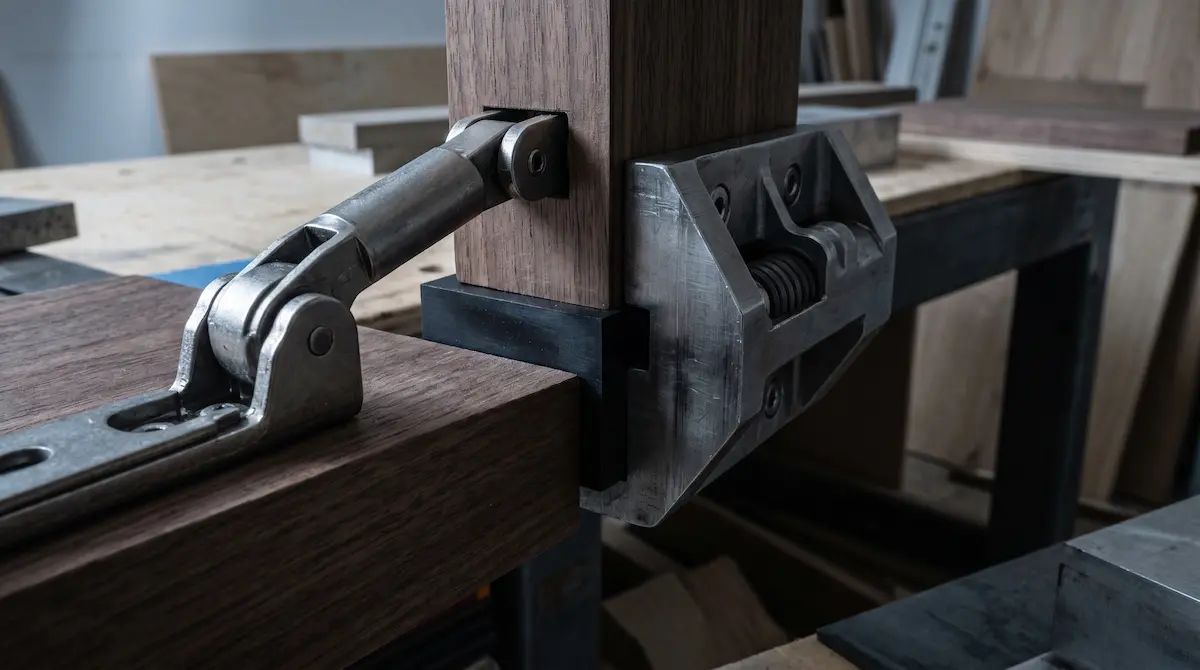
At 02:10 a guest in the adjacent room turns over, and the bed frame releases a 45 to 55 dB creak where the wood screws have worked loose. Down the corridor a wardrobe door falls shut on an undamped hinge and peaks above 65 dB. Guestroom ambient noise sits near 30 dB(A), so both events land squarely in the audible band, and the front desk logs them as poor soundproofing. Engineering then inspects the partition wall and the door undercut, while the noise is being generated by the furniture itself. On most FF&E procurement schedules, hinges and runners are specified with one word, quiet, carrying no sound level, no cycle count, and no test standard.
In late-night hotel operations, when ambient background noise drops below , bed frames creaking () under occupant movement due to loose mechanical tolerances, wardrobe and mini-bar doors slamming (), and rough drawer runner ball-bearing friction sound deafeningly loud. This furniture noise transmits directly through partition walls into adjacent guestrooms, triggering midnight complaints, room reassignments, negative OTA reviews, and rapid asset depreciation.
Sunder integrates hardware silencing technology, hydraulic fluid damping, and structural acoustic decoupling into manufacturing standards through B2B Value Engineering (VE) and architectural acoustics, so that closing sound level, cycle count, and absorption coefficient each become a number an inspector can check on site.
1. Physical Classification of Furniture Noise: Airborne vs. Structure-Borne Noise
Furniture noise operates via two distinct physical propagation paths, each requiring specific decoupling mechanisms:
+-------------------------------------------------------------------------+
|     2 Physical Acoustic Propagation Pathways & Engineering Defenses     |
+-------------------------------------------------------------------------+
|  [Noise Mode 1: Structure-Borne Noise]                                  |
|   Bed frame flex / floating credenza hum ──► Transmitted through floor/ |
|                                              stud wall ──► Wakes guest  |
|   【Engineering Defense】➔ Resilient EPDM Isolation Washers + Carbon    |
|                          Steel Threaded Sleeves (TL >= 18 dB)           |
|                                                                         |
|  [Noise Mode 2: Airborne Impact Noise]                                  |
|   Cabinet door slam / drawer recoil ────────► Radiates through air      |
|                                               medium ──► 65dB+ spikes   |
|   【Engineering Defense】➔ Multi-Stage Hydraulic Damping Hinges         |
|                          (Linear soft-close, Impact level <= 25 dB)     |
+-------------------------------------------------------------------------+
+-------------------------------------------------------------------------+
| Kinetic Energy Dissipation Curve in Door Soft-Closing |
+-------------------------------------------------------------------------+
| Sound Level (dB) |
| ▲ |
| 70│ [Standard Friction Hinge] ──► Violent uncontrolled slam (68 dB) |
| │ \ |
| 50│ \ |
| │ \ |
| 30│ \ |
| 25│ [Sunder Hydraulic Damping] ───────═════════════► Silent (<= 25 dB)|
| 0└────────────────────────────────────────────────────────► Time (sec)|
+-------------------------------------------------------------------------+2. 4 Core Furniture Hardware Silencing & Structural Decoupling Methods
Sunder enforces standardized acoustic specifications across the four highest-frequency dynamic furniture items in luxury guestrooms:
+-------------------------------------------------------------------------+
|        Sunder 4-Layer Acoustic Hardware & Decoupling Cross-Section      |
+-------------------------------------------------------------------------+
|  [Layer 1: Sound Absorption] Headboard Leather Upholstery + Poly Felt   |
|                              (ASTM C423 / ISO 354 NRC >= 0.65)          |
|                                │                                        |
|  [Layer 2: Fluid Damping]    Heavy-Gauge Multi-Stage Hydraulic Hinges   |
|                              (Soft-close impact <= 25 dB)               |
|                                │                                        |
|  [Layer 3: Synchronized Run] Undermount POM Self-Lubricating Slides     |
|                              (ANSI/BHMA Grade 1, 60,000 test cycles)    |
|                                │                                        |
|  [Layer 4: Decoupling Joint] High-Carbon Steel Bushings + 2.0mm EPDM    |
+-------------------------------------------------------------------------+
1. Bed Frame Base: High-Carbon Steel Threaded Bushings & Resilient Damping Washers
- Eliminates wood screws directly driven into timber (which loosen over time). Sunder embeds M8/M10 high-carbon steel threaded bushings.
- Sandwiches flame-retardant micro-cellular EPDM damping washers at all timber-to-metal and timber-to-timber contact interfaces, eliminating dry-rub friction squeaks during guest movement.
2. Wardrobe & Mini-Bar Doors: Multi-Stage Hydraulic Fluid Damping Hinges
- Heavy-duty cold-rolled steel hinges incorporate bidirectional fluid pistons with an opening angle of . During the final of closure, the hinge automatically engages linear damping.
- Soft-closing impact sound is strictly capped at (close to guestroom ambient background noise), cushioned by micro-valved transparent silicone bumpers at corner frames.
3. Drawer Systems: Undermount Full-Extension Synchronized Quiet Runners
- Utilizes POM (polyoxymethylene) self-lubricating quiet rollers and rack-and-pinion synchronization gear mechanisms, ensuring uniform glide resistance.
- Certified under ANSI/BHMA A156.9 Grade 1 commercial standards, tested over 60,000 dynamic cycles under a proof load without roller chatter or binding.
4. Headboard Wall Panels: ASTM C423 Acoustic Sound Absorption
- Headboard panel cores incorporate high-density acoustic polyester fiber batting (density ) wrapped in full-grain leather or flame-retardant fabric.
- Delivers a Noise Reduction Coefficient of (tested under ASTM C423 / ISO 354), absorbing vocal frequencies () and eliminating flutter echoes.
3. Hotel Guestroom Acoustic Engineering Matrix
Guestroom Functional Furniture Acoustic Compliance Matrix
| Spatial Component | Common Acoustic Defect | Sunder Silencing Spec |
|---|---|---|
| Bed Frame Base | Squeaking joint friction | M8 Bushings + EPDM |
| Wardrobe / Mini-Bar | Violent door slamming | Fluid Damping (≤25dB) |
| Desk Drawer Slides | Roller chatter / rattling | POM Synchronized |
| Floating Media Console | Soundbar vibration hum | Resilient wall pads |
| Headboard Millwork | Echo reverberation | Acoustic (NRC ≥ 0.65) |
4. Synergistic Moisture Protection & Acoustic Tolerance Stability
In high-humidity subtropical climates, timber expansion distorts factory hardware alignments, causing doors and drawer boxes to rub against carcases and generate secondary scraping noises:
- Zero-Moisture PUR Edge Sealing: Cabinet components utilize Polyurethane Reactive (PUR) hot-melt edge-banding, limiting substrate water-absorption thickness swelling to , keeping hardware clearances within over 10 years.
- Corrosion-Resistant Hardware: All slides and hinges pass ASTM B117 96-hour neutral salt spray tests, preventing rust-induced runner squealing.
5. Total Cost of Ownership (TCO): Substandard Hardware vs. Sunder Acoustic Engineering
10-Year TCO Evaluation: Substandard Assembly vs. Sunder Acoustic Spec
| Evaluation Vector | Substandard Commercial Spec | Sunder Acoustic Spec |
|---|---|---|
| Door Slam Sound Level | 65 ~ 72 dB (Loud impact) | <= 25 dB (Ultra-quiet) |
| Bed Dynamic Squeaking | Squeaks within 6 months | 10 Years Zero-Squeak |
| Slide Durability Cycles | Fails at 10,000 cycles | 60,000 Cycles Rated |
| Noise Complaint Rate | 3% ~ 5% Room Reassignments | 0 Noise Complaints |
| OTA Review Impact | Negative reviews hurt ADR | Protects Brand ADR |
| 10-Year Cumulative TCO | Baseline (100% + Repairs) | Reduced to 35% (-65%) |
6. Conclusion: Engineering Silence as a Prime Institutional Asset
In luxury hospitality, silence is the most valuable yet frequently compromised guest amenity. Furniture must function not merely as visual decor, but as an active guardian of room acoustics.
Sunder embeds hydraulic fluid damping, carbon steel threaded bushing decoupling, and ASTM C423 acoustic absorptions directly into production quality standards. At handover, ask for three documents: the measured closing sound level for the door hardware, the ANSI/BHMA A156.9 Grade 1 cycle report for the runners, and the ASTM C423 absorption data for the headboard build-up. Note the boundary as well. This scope covers noise the furniture itself generates; airborne transmission through partition walls, corridor door closers, and plant-room low frequencies belong to base-build acoustics and cannot be fixed by a furniture specification.