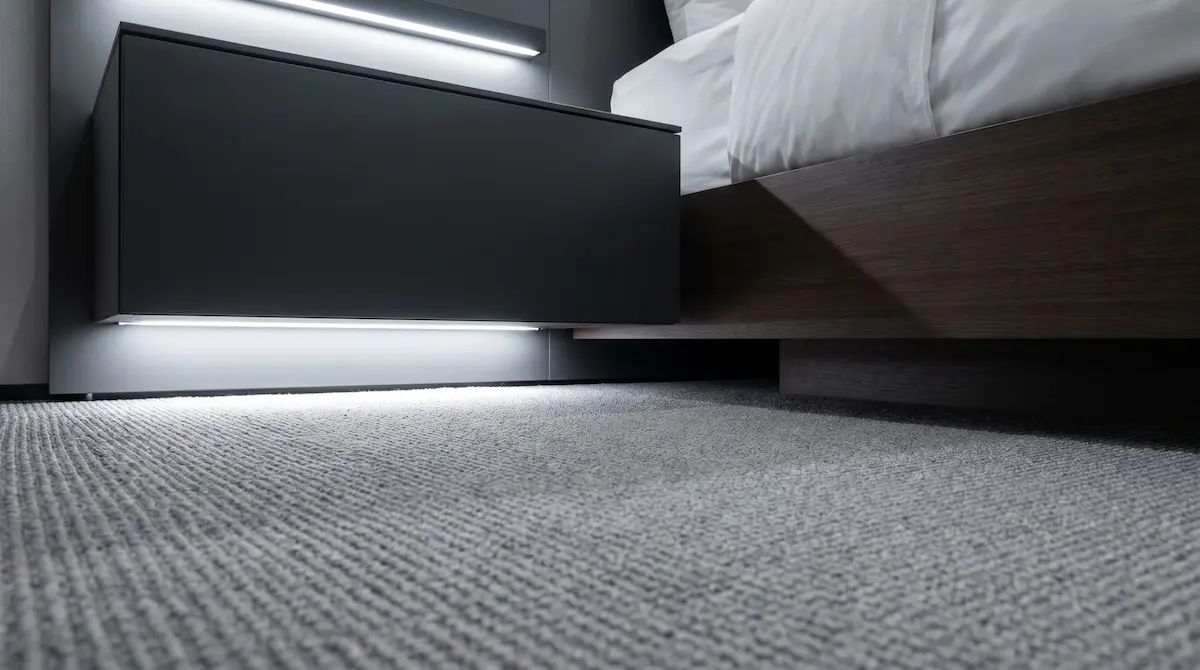
Housekeeping headcount is a division: keys times minutes per room, over the productive hours in a shift. The denominator belongs to the rota. The numerator is usually lifted straight from the brand standard, 30 to 40 minutes, and part of that figure is not human speed but dimension — the clearance under the bed, whether the desk top holds fingerprints, whether the headboard comes apart. All three are fixed on the shop drawings, close to a year before the first housekeeper is hired.
The same dimensions set a second interval. A work order against a dead headboard USB module closes at two hours. Five minutes of that is the repair: unplug the failed module, fit the replacement, confirm power. The rest goes on opening the back panel, pulling cable, reassembling and touching in the finish. That is access time. It reaches the OpEx line multiplied by a labour rate, and its length is set by how the panel is fixed, not by the technician.
Both intervals come out of one geometry, and after installation neither moves without structural work. What follows turns them into clauses a specification can carry, and ends with the rooms where none of it pays for itself.
1. Where the two intervals go: cleaning path and service access
Conventional guestroom layouts spend hours on motions unrelated to cleaning or repair:
+-------------------------------------------------------------------------+
|        Where the two intervals go: conventional vs zero-friction        |
+-------------------------------------------------------------------------+
|  [Conventional high-friction guestroom]                                 |
|   Bed clearance <8cm  ─► vacuum binds    ─► kneel or move bed  +1.5 min |
|   High-gloss desk     ─► smudges show    ─► buff three passes  +0.8 min |
|   Absorbent sofa      ─► coffee soaks in ─► extractor needed   +5.0 min |
|   Screwed headboard   ─► panel comes off ─► refit, touch in    +120 min |
|                                                                         |
|  [Zero-friction engineered guestroom]                                   |
|   Clearance >=150mm   ─► vacuums and robots pass through       -1.5 min |
|   AF nano top coat    ─► one damp microfibre pass              -0.8 min |
|   Repellent fabric    ─► liquid beads, blotted off             -0.7 min |
|   Magnetic hatch      ─► off in 15 s, module swapped              5 min |
+-------------------------------------------------------------------------+
Both intervals have the same shape. The action that produces the value — one wipe, one module swapped — takes a stable amount of time; what stretches is the approach to it. Cleaning equipment approaches the floor, the technician approaches the MEP module, and one piece of furniture either lets them through or does not.
2. Four zero-friction details: structural geometry and surface chemistry
Seen in cross-section, both approaches share one skeleton: the service interface above the carcass, the floor clearance below it.
+----------------------------------------------------------------------+
|  Cantilevered steel and a magnetic hatch: one carcass, two intervals |
+----------------------------------------------------------------------+
|  ┌──────────────────────────────────┐                                |
|  │ Headboard / media console body   │                                |
|  │  ┌────────────────────────────┐  │                                |
|  │  │ NdFeB latches, >= 5 kg each│  │ ──► Technician lifts the       |
|  │  ├────────────────────────────┤  │     panel off in 15 s and      |
|  │  │ [Tool-free access hatch]   │  │     swaps Type-C / RCU / PSU   |
|  │  └────────────────────────────┘  │     with no joinery removed    |
|  └────────────────┬─────────────────┘                                |
|                   │ Cold-rolled steel cantilever, proof load 150 kg  |
|   ▲ Clearance     │                                                  |
|   │ >= 150 mm     │ Vacuum heads and robots pass without moving bed  |
|   ▼               │                                                  |
|  ═════════════════╧═══════════════════════════════════ Floor         |
+----------------------------------------------------------------------+
1. Cantilevered steel: ≥ 150 mm clearance, ≥ 150 kg proof load
- Nightstands, desks and media consoles sit on concealed cold-rolled steel cantilevers (Q235B, wall thickness ≥ 3.0 mm) embedded in the wall or a reinforced backing panel. FEA confirms a single-point downward proof load of ≥ 150 kg — the approach set out in invisible steel.
- The ≥ 150 mm gap underneath lets vacuum heads and robotic cleaners run straight through, so nobody kneels under a bed or pushes a bed base aside and back.
2. Fifteen-second magnetic MEP hatches
- Panels over headboard sockets, USB-C modules and the room control unit (RCU) locate on neodymium (NdFeB) magnets rated ≥ 5 kg per latch.
- No screwdriver, no pry bar: the panel comes off single-handed in 15 seconds and re-seats on the same magnets, reveal intact, nothing to touch in. Cut-outs and cable routing are settled earlier — see MEP interface integration.
3. Anti-fingerprint tops and repellent upholstery
- Desks, mini-bars and coffee tables carry a matte anti-fingerprint nanolayer, water contact angle ≥ 110°. Prints do not spread across it, so a damp microfibre pass usually clears the surface without a chemical degreaser.
- Sofa and bench fabrics carry a fluorocarbon repellent finish; liquid beads and rolls off, resisting penetration for 24 hours under laboratory conditions. A spill caught in time is blotted with a paper towel; dried or pigmented stains still need an extractor, so the finish lowers how often one is called for rather than removing the need.
4. Crevice-free reveals and tool-free adjustment
- Decorative grooves go, chamfers are held to an R0.5 mm shadow gap, and edges are sealed with PUR hot-melt, reducing where dust, hair and crumbs lodge.
- Drawers run on damped slides rated for 60,000 cycles with tool-free three-dimensional adjustment (±2 mm) and closing sound pressure ≤ 25 dB. Replacing a part rather than a whole piece follows modular design.
All four sit in the same place on a value engineering matrix: none changes what a guest sees, and each changes how many times a day someone repeats a motion.
3. Guestroom component against detail
Guestroom component x conventional detail x zero-friction spec
| Component | Conventional detail | Zero-friction spec |
|---|---|---|
| Under bed / carcass | Under 8 cm, hand reach | Floating, >= 150 mm |
| Desk and coffee table | High gloss, holds oils | AF matte nanocoat |
| Sofa and bench | Absorbent, soaks in | Repellent, 24 h hold |
| Wardrobe reveals | Deep grooves, trap dust | R0.5 mm shadow gap |
| Pulls and hardware | Protruding, catch cloth | Integrated J-pull |
| Headboard MEP zone | Screwed shut, demo | Magnetic hatch, 15 s |
The left column is the route housekeeping walks daily; the right is one line on a shop drawing. Nothing sits between them — what the specification omits, the floor pays for in hours.
4. A 300-key model with both labour lines in it
Modelled on 300 keys at ADR NTD 6,000 and 75% occupancy, with housekeeping and engineering hours in one table:
300 keys: housekeeping hours, access time, annual OpEx delta
| Modelled line | Conventional | Zero-friction |
|---|---|---|
| Daily floor vacuuming / room | 3.5 min | 2.0 min, -1.5 |
| Daily surface wiping / room | 1.8 min | 1.0 min, -0.8 |
| Daily spot cleaning / room | 1.2 min | 0.5 min, -0.7 |
| Housekeeping hours, 300 keys | Baseline | 5,475 hours saved |
| One MEP module swap | 120 min, demo | 5 min, magnetic |
| 150 service events / year | 300 hours | 12.5 hours |
| Hours x NTD 220 / hour | NTD 0 | NTD 1,267,750 / yr |
| Out-of-order loss, 75 nights | NTD 337,500 / yr | NTD 0 |
| Annual OpEx delta | Baseline | approx NTD 1.605 m |
| 5 years: undiscounted / at 7% | Baseline | NTD 8.03 m / 6.58 m |
Assumptions: 300 keys, 3.0 minutes saved per room per day, every room serviced daily, 150 MEP service events a year, access time per event falling from 120 minutes to 5, and a fully loaded labour cost of NTD 220 per hour. Out-of-order loss treats roughly half the events as costing one night, valued at ADR NTD 6,000 times 75% occupancy. On those inputs the annual delta is about NTD 1.6 million; five years is about NTD 8.03 million undiscounted, or NTD 6.58 million at a 7% discount rate.
The denominator keeps it honest. Baseline housekeeping under the same assumptions runs about 63,875 hours a year across 300 keys, so 5,762 hours saved is close to 9%, or 2.9 full-time equivalents at 2,000 hours each. That 9% reaches the P&L only if the rota shrinks or the same team absorbs more rooms. At lower occupancy, or where housekeeping is contracted per room rather than by roster, saved minutes do not convert one-for-one into payroll.
5. Ten-year TCO and the load on frontline staff
10-year TCO: floor-bound joinery vs zero-friction engineering
| Evaluation vector | Floor-bound joinery | Zero-friction system |
|---|---|---|
| Room turnaround | 35 to 40 minutes | 30 to 32 minutes |
| Vacuuming path | Dead zones, bed moved | Floating, >= 150 mm |
| Cleaning chemicals | Degreaser kept in stock | Water on most tops |
| Upholstery extraction | Quarterly machine runs | Blotted when caught |
| MEP access time | 1 to 2 h, joinery demo | 15 s magnetic hatch |
| Room during service | Pulled from sale | Most jobs in place |
| Furniture unit price | Baseline | Higher: steel, magnets |
| 10-year labour OpEx | Baseline 100% | ~91%, see section 4 |
Read the last two rows together. Cantilever brackets need embedding and magnetic hatches add a machining operation, so the unit price sits above a floor-bound plinth. Whether it returns depends on key count, occupancy and MEP fault frequency; the arithmetic is in the hotel furniture TCO model. Claims that this detailing cuts ten-year OpEx to a third generally count cleaning-hour savings as total OpEx savings, and the two differ by an order of magnitude.
Ergonomic load is the other consequence of the same geometry, and one of the few social metrics in an ESG report that can be counted:
- Fewer bend-and-lift cycles. Floor clearance removes the need to kneel or shift a bed base to vacuum, cutting the frequency of the highest lumbar-load motions in a round. Musculoskeletal disorder rates still depend on roster density and other tasks, so furniture addresses one contributor among several.
- Better retention conditions. Lower physical load shows up in onboarding cost and workers’ compensation exposure, though the size of that effect depends on pay and management practice and should not be credited to a furniture specification alone.
6. Conclusion: measure the site before writing the clauses
The method has boundaries worth ruling out at drawing stage:
- Walls that cannot carry the load. A cantilever needs a wall or backing panel able to take the moment. Where lightweight partitions were built without embedded reinforcement, slim metal legs holding the same ≥ 150 mm clearance beat forcing a wall fixing.
- Properties with simple MEP. On a small key count, with sockets in the headboard but no RCU or fast-charging module, magnetic hatches may not return their added cost.
- Outsourced per-room housekeeping. Saved minutes return to the contractor’s productivity, not the owner’s payroll. There the clauses worth writing are the repellent finishes, not the full cantilever package.
Three things can be measured before any of this is specified: the wall build-up and where reinforcement can be embedded; three years of work orders, showing which fault dominates and what access time it consumes; and a timed turnaround in the mock-up room. Room type, furniture count and the cleaning equipment already in service all move the 3.0-minute figure. A mock-up room sign-off is the one chance before tender to replace a brochure figure with your own.