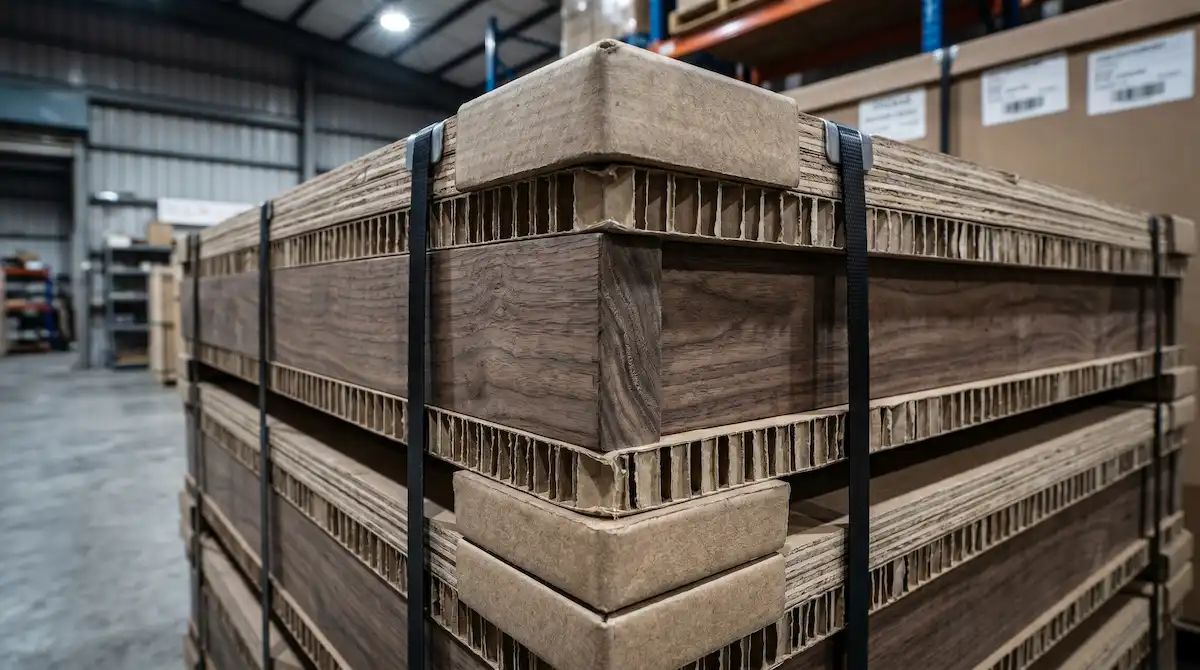
A question that comes up in most FF&E tenders: why does one 300-key package load into 23 40HQ containers when another needs 35? The answer sits in the outer packing dimension. Whether that dimension divides evenly into a container’s 2,350 mm internal width and 2,690 mm internal height sets how much void is left inside, and therefore what share of the ocean freight invoice pays to move air. The variable is fixed during structural design; by the time space is booked, the only lever left is how boxes are consolidated. A 40HQ offers 76.2 CBM gross against a practical loading limit near 68 CBM, and every landed-cost figure downstream works from there.
Transporting custom casework across thousands of nautical miles—spanning ocean freight, customs clearance, port drayage, and final room placement—is an intense physical trial against volumetric space (CBM), dynamic vibration, and on-site installation deadlines. If procurement decisions focus strictly on ex-factory figures while ignoring wasted container air, transit shock risks, and chaotic field assembly friction, projects face exploding container freight invoices, transit-damaged components that cannot be replaced in time, out-of-spec field tolerances, and opening dates that move.
Sunder integrates B2B Value Engineering (VE) and Landed Cost Engineering, deploying 3D container geometry algorithms, semi-preassembled modular structures, and ISTA 3A packaging tests, so container count, damage rate and site labor appear on one cost sheet.
1. Mathematical Model of Total Landed Cost in Cross-Border Hotel Procurement
In asset management finance, the true landed cost of commercial casework incorporates all cross-border friction coefficients:
Where:
- : Factory FOB procurement price
- : Maritime and inland freight costs (dictated strictly by total packaged CBM volume)
- : Replacement and repair expenses resulting from transit shocks, crushing, or moisture rot
- : Direct on-site contractor labor payroll required for room delivery, unboxing, and leveling
- : Net room revenue losses incurred when logistics delays postpone the grand opening date
+-------------------------------------------------------------------------+
|        40HQ Container Payload Efficiency: Unoptimized vs. Sunder CBM    |
+-------------------------------------------------------------------------+
|  【Conventional Fully-Assembled Packaging (Payload Volume: 60% ~ 65%)】 |
|   ┌─────────────────────────────────────────────────────────────────┐   |
|   │ [Lounge Sofa]   [King Headboard (Shipping massive air)] [Voids] │   |
|   └─────────────────────────────────────────────────────────────────┘   |
|    ➔ 300 Keys requires 35x 40HQ containers ➔ Runaway ocean freight bill |
|                                                                         |
|  【Sunder Semi-Preassembled 3D Modular Loading (Payload: 90% ~ 92%)】   |
|   ┌─────────────────────────────────────────────────────────────────┐   |
|   │ [Welded Core] [High-Density Flatpack Panels] [Nested Volumes]   │   |
|   └─────────────────────────────────────────────────────────────────┘   |
|    ➔ 300 Keys requires only 23x 40HQ containers ➔ Saves 12 containers!  |
+-------------------------------------------------------------------------+
2. 40HQ Container CBM Geometric Algorithms & Payload Maximization
A standard 40-foot high-cube container (40HQ) has internal dimensions of , offering a gross volume of with a practical loading limit of .
Sunder embeds CAD 3D Container Packing Algorithms at the initial design drafting phase:
- Volumetric Modular Sizing: Packaging outer dimensions are exact integer divisors of internal container widths (2,350mm) and heights (2,690mm), eliminating ceiling and wall void gaps.
- Volumetric Nesting: Hollow internal cavities of credenzas and wardrobes house nightstands and accent chairs, achieving secondary spatial utilization.
- Payload Utilization: For guestroom sets built around headboards, wardrobes and accent chairs, measured container utilization moves from roughly to . Public-area sets built around sofas and sculpted lounge chairs are irregular in outline and typically stop near 78%.
+-------------------------------------------------------------------------+
|         Sunder Semi-Preassembled (KD) Rapid On-Site Joinery Model       |
+-------------------------------------------------------------------------+
|  [Factory 360° Welded Core Skeleton] ──► Guarantees 100k-cycle strength |
|             │                                                           |
|  [M8 Hardened Steel Threaded Bushings] ──► 4 Bolts fastened in 3 minutes |
|             │                              (Zero tolerance stacking)    |
|  [High-Density Flatpack Extensions] ──► 60% Volume compression with     |
|                                         20mm honeycomb edge defense     |
+-------------------------------------------------------------------------+
3. ISTA 3A Transport Packaging Test Standards
Maritime shipments endure extreme vessel roll, pitch, and rough dock crane handling. All Sunder export packaging passes ISTA 3A (International Safe Transit Association) laboratory testing:
ISTA 3A Safe Transit Verification & Packaging Specifications
| Inspection Vector | Simulation Environment | Sunder Packaging Armor |
|---|---|---|
| 10-Point Free Drop | 900mm Drop on Corners/Edges | 20mm Honeycomb + L-Pads |
| Random Vibration | 3,000 Nautical Mile Waves | EPE Foam Non-Scratch Wrap |
| Climate Chamber | -20°C ~ 60°C, 95% RH Vapor | Aluminum Vacuum Bag+Desiccant |
| Stacking Top Load | 500 kg Static Load (72h) | 5-Ply Heavy-Duty Carton |
4. On-Site Labor Actuary: Installation Time Slashed from 4 Hours to 25 Minutes
Hospitality job sites are chaotic environments characterized by heavy dust, trade clashes, and zero heavy machinery:
300-Key Hotel On-Site Installation Labor & Landed Cost Actuary
| Actuarial Parameter | Conventional Flat-Pack | Sunder Semi-Preassembled |
|---|---|---|
| Assembly Time per Room | 4.0 Hours / Room | 25 Minutes / Room |
| Total Assembly Hours (300 keys) | 1,200 Labor Hours | 125 Hours (-90%) |
| Installation Crew Required | 15 Installers x 10 Days | 3 Installers x 5 Days |
| Direct On-Site Labor Payroll | NT$ 750,000 | NT$ 75,000 |
| 40HQ Container Count Required | 35 Containers | 23 Containers |
| Total Maritime & Drayage Freight | NT$ 5,250,000 | NT$ 3,450,000 |
| Transit Damage & Rework Rate | 6% ~ 8% Severe Chipping | 0% Zero Damage |
| Net Direct Landed Cost Savings | Baseline | Saves NT$ 2.55M |
5. Total Cost of Ownership (TCO): Unoptimized Logistics vs. Sunder Landed Cost VE
10-Year TCO Evaluation: Conventional Freight vs. Sunder Logistics VE
| Evaluation Vector | Unoptimized Assembly / Box | Sunder CBM / ISTA 3A |
|---|---|---|
| Container Payload Ratio | 60% ~ 65% (Wasted space) | 90% ~ 92% (Max Pack) |
| Shipping Transit Damage | 5% ~ 8% Chipped Panels | 0% Transit Damage |
| Job-Site Rework Rate | High (Field touch-ups) | Zero Rework (KD-Fit) |
| Opening Delay Risk | Severe (Waiting for spares) | Zero Opening Delays |
| 10-Year Cumulative TCO | Baseline (100% + High Freight) | Reduced to 34% |
6. Conclusion: Engineering Supply Chain Predictability into Opening Day Yields
In the competitive development of international commercial hospitality, logistics is not a passive shipping chore; it is active engineering that governs final Landed Cost and capital return velocity.
Sunder embeds 3D container geometry algorithms, semi-preassembled modular structures, and ISTA 3A packaging defense directly into production blueprints. Through mathematical discipline, we reduce freight volume and transit damage. One limit worth stating: below about 80 keys, tooling and jig cost for modular packing does not amortize, and conventional crating is the cheaper answer.
Further Reading
- Hotel Brand Standards & FF&E Compliance Engineering: Marriott, Hilton, and IHG Technical Specifications Unpacked
- Hotel Room Functional Furniture & MEP Integration Engineering: Pre-Routed Wire Management, Thermal Dissipation Channels, and Quick-Release Maintenance in Nightstands, Mini-Bars, and TV Consoles
- Hotel Furniture RFP & Tender Specification Defense: Securing Quality Craftsmanship and Project Delivery Schedules