Modelled over ten years on a 2.5-year replacement interval, freight and landfill included, an eco-labelled piece that fails early carries roughly 3.8x the Scope 3 carbon of a 10-year build. The certificate is not what moves that number; the service life is. Each avoided cycle removes one manufacturing run, one shipping leg and one disposal event from the inventory at once. So the opening question in an ESG furniture review is not which label the supplier holds, but how long the frame stays square and whether a failed cushion can be replaced without scrapping the piece.
However, during conventional B2B procurement strategies, developers frequently stumble into the “Greenwashing Trap”. Suppliers market fragile “bio-composite” or “recycled plastic” furniture that structurally fails within 2 to 3 years of commercial use. In rigorous carbon accounting, modelled over 10 years on a 2.5-year replacement interval and including ocean freight and landfill disposal, disposable furniture carries roughly 3.8x the Scope 3 carbon footprint of engineered 10-year durable contract furniture.
Sunder integrates B2B Value Engineering (VE) and Circular Economy 4R Architecture, treating service life as the primary decarbonization variable: a frame that stays in place for 10 years avoids two manufacturing runs and two shipping legs outright.
1. The Greenwashing Trap vs. Physical Material Durability Life Cycle Model
In environmental engineering and carbon accounting, a material’s “initial green label” is far less consequential than its “physical operational lifespan”:
+-------------------------------------------------------------------------+
|        10-Year Cumulative Carbon & Resource Depletion Trajectory        |
+-------------------------------------------------------------------------+
|  Cumulative Carbon Footprint (kg CO₂e / Room)                           |
|    ▲                                                                    |
| 800│                                    / [Disposable Greenwashed FF&E] |
|    │                                   /  (Manufactured 3x + Ocean 3x)  |
| 600│                                  /                                 |
|    │                                 /                                  |
| 400│                                /                                   |
|    │                               /                                    |
| 200│   [Sunder 10-Year Modular Engineered Furniture] ══════════════════ |
|    │  (100% FSC + Modular Re-Skinning ➔ Zero Frame Scrapping ➔ Low C)   |
|   0└──┴──────────────────────────┴──────────────────────────► Time (Yrs)|
|        0 (Opening)              5 (Year 5)                  10 (Year 10)|
+-------------------------------------------------------------------------+
+-------------------------------------------------------------------------+
| Circular Economy 4R Closed Loop vs. Linear Take-Make-Waste Trap |
+-------------------------------------------------------------------------+
| 【Conventional Linear Take-Make-Waste Paradigm】 |
| Procure low-spec FF&E ──► Surface fails in 2 yrs ──► Landfill dump |
| ➔ Total carbon and financial capital destruction |
| |
| 【Sunder Circular Economy 4R Sustainable Closed-Loop Architecture】 |
| ┌─────────────────────────────────────────────────────────────────┐ |
| │ 1. Reduce: Value Engineering optimizes joinery, cutting waste 25%│ |
| ├─────────────────────────────────────────────────────────────────┤ |
| │ 2. Reuse: Rigid Q235B welded frames remain in-service 15+ years │ |
| ├─────────────────────────────────────────────────────────────────┤ |
| │ 3. Repair: Decoupled modular cushions hot-swapped in 3 minutes │ |
| ├─────────────────────────────────────────────────────────────────┤ |
| │ 4. Recycle: 100% Post-consumer metallurgical recyclability │ |
| └─────────────────────────────────────────────────────────────────┘ |
+-------------------------------------------------------------------------+2. Sustainable Capital Valuation & Enterprise Value Expansion Model
In modern corporate finance, superior ESG performance directly reduces the Weighted Average Cost of Capital (WACC) while unlocking institutional valuation premiums:
ESG Sustainable Capital Impact on Hotel Portfolio Valuation
| Capital Vector | Disposable Greenwashed FF&E | Sunder Sustainable |
|---|---|---|
| Green Financing Spread | Standard borrowing rate | 20 bps loan rebate |
| Institutional Multiples | Subordinated by ESG scrutiny | +0.5x EV/EBITDA |
| Corporate Master RFP | Excluded by Fortune 500 RFPs | Preferred Tier-1 |
| Brand Reputation Risk | Hardware failure PR disaster | Zero guest claims |
3. 4 Core Brand-Trust Protective Procurement Standards
Sunder transforms “brand trust” into enforceable contract manufacturing specifications:
1. 100% Full-Lifecycle Digital Product Passports
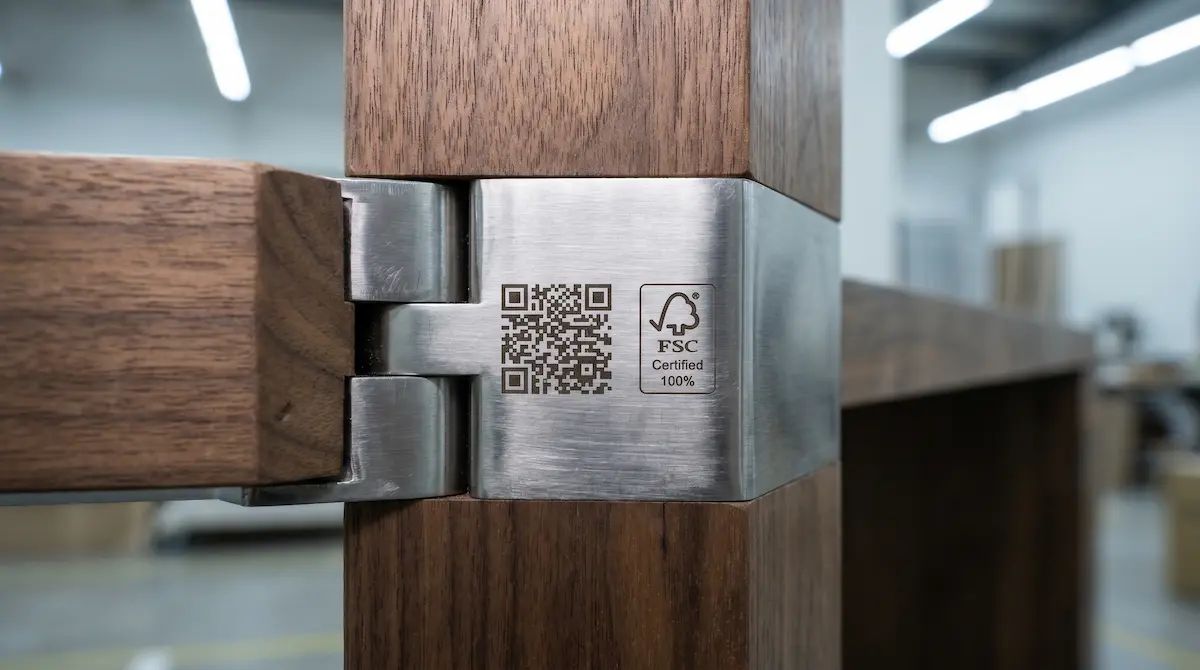
- Every manufactured unit carries a digital traceability QR code logging its FSC forest concession code, JIS F☆☆☆☆ chamber test certificate, and TVOC emission ratings, fully satisfying third-party ESG audits.
2. Physical Protective Barrier & Zero-Odor Guestrooms
- Utilizing room-temperature-cured waterborne PU and 100% solids UV lacquers, guestrooms achieve Zero Toxic Off-Gassing (TVOC ) upon handover, verified by chamber test at handover rather than judged by smell.
3. Human Safety Engineering & 3D Radius Detailing
- All exposed edges are 5-axis CNC profiled with an radius with zero exposed fasteners or metal burrs, which removes the sharp-corner item from the property’s incident checklist.
4. Non-Disruptive In-Room Rapid Maintenance
- Modular upholstery units are swapped in 180 seconds inside the guestroom, eliminating the visible transit of damaged furniture through public corridors.
4. Actuarial Quantification: 10-Year Sustainable Capital Returns Across 300 Keys
300-Key Hotel 10-Year Sustainable Capital & TCO Actuary
| Actuarial Parameter | Disposable Greenwashing | Sunder Capital |
|---|---|---|
| 10-Year FF&E Capital Outlay | NT$ 75,000,000 (2 Scraps) | NT$ 35,400,000 |
| Solid Waste Disposal Tipping | NT$ 1,500,000 (Tons) | NT$ 150,000 |
| 10-Year Green Loan Rebate | NT$ 0 | NT$ 3,000,000+ |
| Fortune 500 Corporate RFP Yield | Baseline | +NT$ 18,000,000 |
| 10-Year Cumulative Scope 3 C | 684 Metric Tons CO₂e | 43.5 Tons (-94%) |
| 10-Year Net Capital Generated | Severe Carbon Deficit | +NT$ 60,000,000+ |
Specifying sustainable capital engineering saves nearly NTD 40,000,000 in replacement CapEx on a model that assumes 300 keys, two avoided full replacements over 10 years, a 20 bps green loan rebate, a 6% ADR uplift on corporate contracts and a 7% discount rate. Change any one of those inputs and the total moves.
5. Total Cost of Ownership (TCO): Disposable Greenwashing vs. Sunder Capital VE
10-Year TCO Evaluation: Disposable Greenwashing vs. Sunder Capital VE
| Evaluation Vector | Disposable Greenwashing | Sunder Sustainable |
|---|---|---|
| Physical Lifespan | 2 to 3 Years (Snaps/Rots) | 10+ Years Stable |
| Field Repairability | Non-repairable (Landfill) | 3-Min In-Room Swap |
| Scope 3 Carbon Impact | 760 kg CO₂e / Room | 145 kg CO₂e / Room |
| Brand Equity Risk | High (Guest negative reviews) | Zero Hardware Flaws |
| 10-Year Cumulative TCO | Baseline (100% + 2 Scraps) | Reduced to 29% |
6. Conclusion: Engineering Sustainability as an Enduring Asset Moat
In institutional hospitality where fiduciary responsibility and long-term stewardship govern asset valuations, authentic luxury is defined not by superficial ornament, but by whether the frame is still square in year eight and whether a damaged cushion can be swapped without removing the piece from the room.
Sunder embeds the circular economy 4R framework, digital product passports, and 10-year durability directly into manufacturing DNA. The 4R framework carries a precondition: frames, cushions and surfaces have to be separable. Fully welded or single-shell products cannot be repaired in place, and the modular argument does not apply to them — ask for the exploded assembly drawing before asking for the eco-label.