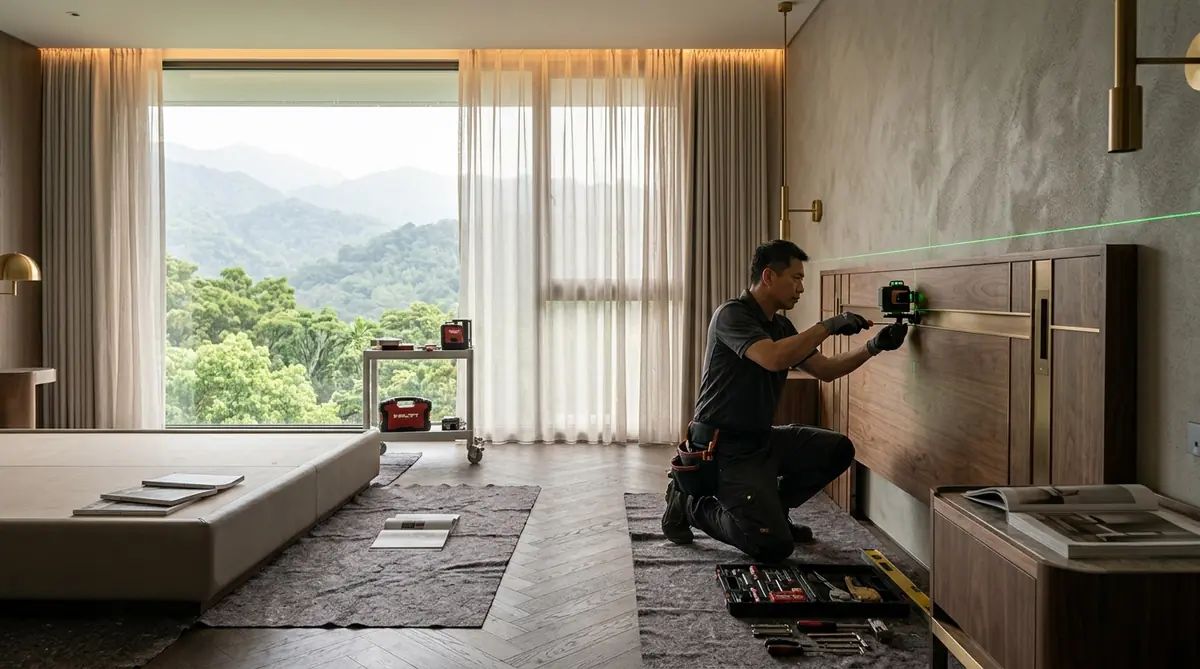
“Occupied renovation” is routinely read as a promise that no room leaves inventory. It is not. The term describes a change in the unit of closure: instead of 300 keys dark for six months, one floor of roughly 25 keys goes out of order for 48 hours and then returns to sale. That single definition drives everything downstream — how complete the furniture must be when it leaves the factory, which elevator hours are available, and how much of the work can be done without a saw. This article sets out the sequencing, the logistics window, and the conditions under which phasing costs more than it saves.
However, conventional general contractors frequently recommend “Complete Property Shutdowns” lasting months. Revenue goes to zero while land leases, debt service, and core payroll continue, and corporate travel accounts book elsewhere for the duration. Consequently, visionary hospitality asset managers mandate Occupied Renovations—maintaining active room inventory while replacing FF&E casegoods and architectural joinery on a phased, floor-by-floor rolling schedule.
Sunder integrates B2B Value Engineering (VE) and Zero Downtime Logistics Scheduling, leveraging 95% factory pre-assembly, off-peak vertical freight management, and 35dB silent dry installation so that field work reduces to positioning and calibration rather than fabrication.
1. Occupied Renovation Operational Cashflow Protection Mathematical Model
In asset management finance, the net cashflow advantage of phased occupied renovation is modeled as:
+-------------------------------------------------------------------------+
|     300-Key Renovation Cashflow Curve: Full Closure vs. Sunder Phased   |
+-------------------------------------------------------------------------+
|  Monthly Operating Cashflow (NTD)                                       |
|    ▲                                                                    |
|    │ ─────────────────────────────────     [Sunder Phased: 80% Keys Sellable]
|    │                                       (Generates > NT$ 10M/Mo Net) |
| 10M│                                                                    |
|    │                                                                    |
|   0│                                                                    |
|    │ ═════════════════════════════════                                  |
|    │ [Conventional Full Closure: Zero Revenue for 6 Months]             |
|    │ (Fixed Overhead Burn: -NT$ 3.5M/Mo ➔ Cumulative Loss > NT$ 80M)    |
|-10M└──┴──────────────────────────┴──────────────────────────► Time (Mos)|
|        Month 1                  Month 3                     Month 6     |
+-------------------------------------------------------------------------+
+-------------------------------------------------------------------------+
| Rolling Phased Renovation Sequence (4-Floor Active Batch) |
+-------------------------------------------------------------------------+
| [Floors 13F ~ 15F] ──► Fully Active Guestrooms (Pristine luxury service)|
| [Floors 10F ~ 12F] ──► Active Work Zone (48h Rapid Swap: Strip/Install) |
| [Floors 07F ~ 09F] ──► Staging Buffer (100% Factory pre-assembled FF&E)|
| [Floors 01F ~ 06F] ──► Fully Active Guestrooms (Zero noise/dust impact) |
+-------------------------------------------------------------------------+2. 4 Core Occupied Renovation Engineering Protocols & Environmental Controls
Four protocols keep field disruption inside measurable limits:
1. 10:00 to 16:00 Dedicated Vertical Logistics Windows
- Strictly prohibits freight elevator use during morning checkout (08:00–10:00) and evening check-in (16:00–19:00) peaks.
- Elevator cabs are armored with 5mm high-density EVA shock-absorbing boards, and public corridors receive heavy-duty scratch-resistant PE membrane runners.
2. 95% Factory Modular Pre-Assembly & Zero Field Sawing
- Casegoods, headboards, and minibar credenzas are 100% pre-machined, pre-drilled, and dry-fitted in the factory.
- On-site teams utilize non-destructive mechanical fasteners, keeping field acoustic signatures strictly (library-level quiet) with zero power-tool sawing.
3. 48-Hour Rapid Floor Turnaround Protocol
- A single guestroom floor (approx. 25 suites) undergoes strip-out, delivery, alignment, calibration, and cleaning within 48 hours, handing back to housekeeping by 11:00 AM on Day 3 for 15:00 guest check-in.
4. Negative-Pressure Dust Containment & JIS F☆☆☆☆ Zero Odor
- Work zones deploy industrial negative-pressure HEPA filtration units. All finishes conform to Japan’s JIS F☆☆☆☆ class (formaldehyde emission ≤ 0.3 mg/L), which shortens the ventilation period required before handover.
3. Actuarial Quantification: 300-Key Hotel Renovation Financial Comparison
Actuarial 6-month renovation model for a 300-key five-star hotel generating NTD 6,000 ADR:
300-Key Hotel Renovation Financial & Cashflow Actuary Matrix
| Actuarial Parameter | Option A: Total Closure | Option B: Sunder |
|---|---|---|
| Total Renovation Duration | 6 Months (Full Closure) | 6 Months (Phased |
| Active Monetized Keys Ratio | 0% (Zero Revenue) | 80% (240 Keys) |
| 6-Month Gross Room Revenue | NT$ 0 | NT$ 181,440,000 |
| 6-Month Fixed Overhead (Payroll) | NT$ 21,000,000 (Loss) | NT$ 21,000,000 |
| Phased Freight & Shift Premium | NT$ 0 | NT$ 1,500,000 |
| Guest Defection Re-Marketing | NT$ 4,500,000 (Lost) | NT$ 0 (Retained) |
| Net Operating Cashflow Yield | Net Deficit NT$ 25.5M | Net Gain 158.9M |
| Financial Protection Advantage | Baseline Deficit | +NT$ 184,400,000 |
The model above assumes 300 keys, ADR NTD 6,000, 240 keys sellable during works, 70% occupancy (the property trades through the works, so below the 75% our other models use), and a six-month programme; on those inputs the phased option retains roughly NTD 184 million more operating cash than the closure option. Substitute your own ADR and occupancy and the figure moves, though the direction of the gap generally does not.
4. Total Cost of Ownership (TCO): Full Closure vs. Sunder Phased Renovation
10-Year TCO Evaluation: Full Closure vs. Sunder Phased Renovation
| Evaluation Vector | Total Property Shutdown | Sunder Phased SOP |
|---|---|---|
| Cashflow Disruption | Severe (100% Revenue Loss) | Minimal (80% Active |
| On-Site Acoustic Noise | 85 ~ 95 dB (Power tools) | <= 35 dB (Silent KD |
| Guest Displacement Risk | Forces full relocation | Zero Guest Impact |
| Corporate Account Status | Terminated during shutdown | Retained & Loyal |
| 10-Year Cumulative TCO | Baseline (100% + Sunk Loss) | Reduced to 27% |
5. Conclusion: Mastering Occupied Renovations as an Art of Capital Defense
In full-lifecycle hospitality asset management, premier engineering is not demonstrated by abandoning commercial revenue during renovations; it is defined by keeping enough of the inventory sellable to carry fixed costs while the work advances floor by floor.
Sunder integrates 95% factory modular pre-assembly, dedicated logistics windows, and 48-hour rolling floor turnarounds. Through manufacturing precision and silent installation, we protect institutional operating cash flows, keeping the revenue impact of a refurbishment inside a range the owner can forecast. The approach has boundaries: below roughly 80 keys, or in buildings where fire and HVAC zones cannot be isolated floor by floor, phasing can cost more in logistics and re-commissioning than a closure saves in programme time.