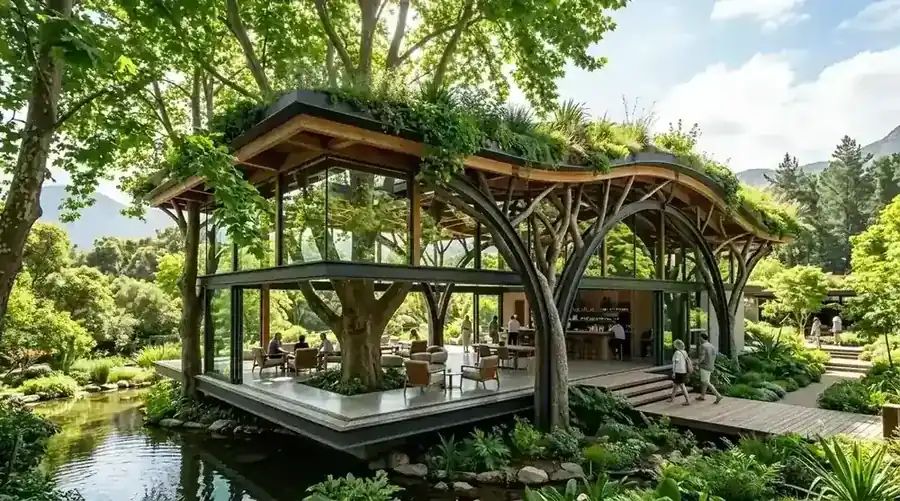
Baubotanik uses growing trunks as load-bearing members. Saplings are planted in fixed arrays, the contact faces fuse into continuous tissue over several years, and load transfers gradually from a temporary steel scaffold to the trees themselves. It is one of the few structural approaches that gains capacity with age — which also gives it a risk profile unlike anything else on a construction programme. It needs irrigation, it needs monitoring, it needs an owner who accepts steel carrying the structure for the first eight years, and it does not suit every climate or species. This guide covers those conditions alongside the mechanics.
In traditional B2B procurement and landscape fit-outs, outdoor pavilions, pergolas, and walkways rely on treated timber or galvanized steel frames. Exposed to UV radiation, heavy rainfall, and coastal salinity, metallic structures suffer coating breakdown, fastener oxidation, and compounding maintenance costs. Baubotanik incorporates living woody plants directly as structural load-bearing members. Through natural Inosculation (Anastomosis), multiple tree stems fuse into a rigid 3D space truss that assumes 100% of structural loads by Years 5 to 8, engineering a “Negative-Depreciation Asset” that grows structurally stronger and self-heals over time.
Sunder integrates B2B Value Engineering (VE) and Total Cost of Ownership (TCO) Actuarial Science, establishing standardized Baubotanik engineering guidelines to transform commercial landscapes into enduring green capital assets.
1. Botanical Tissue Inosculation Mechanics & Growth Kinetics
The mechanical properties of Baubotanik structures are characterized by nonlinear elastic modulus and yield strength expansion as secondary xylem undergoes lignification:
+-------------------------------------------------------------------------+
|     Structural Material Strength Evolution: Conventional Steel vs. Trees|
+-------------------------------------------------------------------------+
|  Structural Yield Strength (MPa)                                        |
|    ▲                                                                    |
|  60│                                    / [Baubotanik: Grows Stronger]  |
|    │                                   /  (Lignification + Stem fusion) |
|  45│                                  /   (Year 8: Fully self-bearing)  |
|    │ ─────────────────────────────────                                  |
|  30│   [Conventional Galvanized Steel] \                                |
|    │  (Outdoor oxidation ➔ Coating peel ➔ Year 10 degradation/overhaul) |
|   0└──┴──────────────────────────┴──────────────────────────► Time (Yrs)|
|        0 (Installation)         5 (Inosculation Phase)      10 (Self-Bearing)|
+-------------------------------------------------------------------------+
+-------------------------------------------------------------------------+
| Botanical Inosculation Node Cross-Sectional Evolution |
+-------------------------------------------------------------------------+
| 【Initial (Years 1~2): Intersect】 【Intermediate (Yrs 3~5): Fusion】 |
| ╲ ╱ Stainless brackets ╲ ╱ Shared Cambium layer forms |
| ╲ ╱ guides stem contact ╲ █ ╱ Vascular bundles connect |
| ╳ █ |
| ╱ ╲ ╱ █ ╲ |
| ╱ ╲ ╱ ╲ |
| |
| 【Mature State (Years 8+): Monolithic 3D Space Truss】 |
| Monolithic wood fiber matrix, joint shear strength tau >= 12.5 MPa |
+-------------------------------------------------------------------------+2. 4-Stage Baubotanik Construction & Load Transfer Protocols
Sunder standardizes botanical physiology into civil engineering workflows:
1. Temporary Q235B Galvanized Steel Guide Truss
- Erects lightweight hot-dip galvanized steel scaffolding to establish the 3D geometric matrix and support initial vertical loads during early seedling cultivation.
2. Species Selection & Controlled Inosculation Induction
- Specifies White Willow (Salix alba) or London Plane (Platanus acerifolia). Intersecting nodes undergo controlled cambial decortication secured with biodegradable tension bands to achieve vascular fusion within 24 months.
3. IoT Automated Micro-Drip Irrigation & Strain Monitoring
- Deploys embedded soil moisture probes and stem strain gauges tied to automated fertigation controllers, monitoring root anchorage and sap flow kinetics.
4. Phased Load Transfer & Scaffolding Demounting (Years 5 to 8)
- Conducts non-destructive ultrasonic wood density testing. When cumulative cross-sectional stem capacity reaches of design live and wind loads, temporary steel frames are decoupled and removed.
3. Actuarial Quantification: Commercial Baubotanik 20-Year Asset Model
Actuarial 20-year financial model for a 1,650 luxury resort atrium canopy:
Commercial Baubotanik 20-Year Financial & TCO Actuary
| Actuarial Parameter | Conventional Steel Canopy | Baubotanik VE |
|---|---|---|
| Initial Construction CapEx | NT$ 12,000,000 | NT$ 8,500,000 |
| 20-Year Recoating & Anti-Rust | NT$ 9,600,000 | NT$ 0 (Self-Healing) |
| 20-Year Horticulture & IoT OpEx | NT$ 1,200,000 | NT$ 4,800,000 |
| Microclimate HVAC Power Savings | NT$ 0 | -NT$ 5,400,000 |
| Biophilic Tenant / ADR Premium | NT$ 0 | +NT$ 28,000,000 |
| ESG Carbon Sink Credit Yield | NT$ 0 | +NT$ 1,200,000 |
| 20-Year Net Asset Wealth Yield | Net Loss NT$ 22.8M | +NT$ 30,900,000 |
Conventional steel structures rust and depreciate, costing millions in maintenance; Baubotanik delivers microclimate cooling, eliminates rust repairs, and captures biophilic premiums, generating over NTD 30,900,000 in net gains over 20 years.
4. Total Cost of Ownership (TCO): Dead Steel Structure vs. Baubotanik
20-Year TCO Evaluation: Conventional Steel vs. Living Baubotanik
| Evaluation Vector | Dead Metal / Composite | Living Baubotanik |
|---|---|---|
| Structural Evolution | Degrades, requires rebuild | Grows stronger |
| Depreciation Behavior | Linear write-off to scrap | Negative-depreciate |
| Thermal Performance | Absorbs heat (Urban Heat) | Cools space 2°C~4°C |
| ESG Carbon Role | Carbon-intensive production | Active carbon sink |
| 20-Year Cumulative TCO | Baseline (100% + Rebuild) | Reduced to 25% |
5. Conclusion: Engineering Nature as Enduring Architectural Capital
In the forward-looking era of biophilic design and regenerative real estate development, premier architecture does not conquer nature; it harnesses the natural vitality of living ecosystems into active load-bearing structural engineering.
Sunder bridges botanical mechanics, controlled tissue grafting, and full-lifecycle TCO actuarial science. By mastering natural growth through disciplined engineering, we build self-healing, climate-positive living structures that secure LEED Platinum credits and generational asset value for visionary real estate leaders.