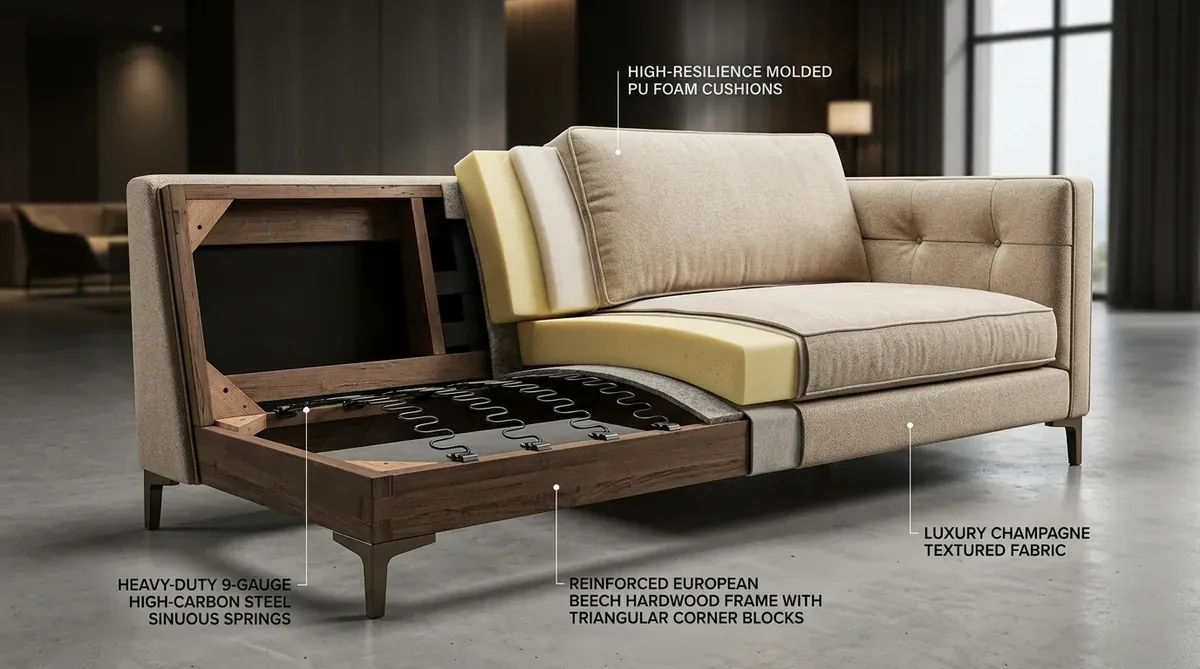
Cut a 10 cm cube from a cushion sample and weigh it: the mass in grams is the density in kg/m³. Twenty-eight grams is commodity foam; forty-five grams is the HR cold-cured foam a lobby sofa needs. A craft knife and a kitchen scale settle that specification at sample stage. The distance between 28 and 45 is what decides whether the centre seat of a three-seat lobby sofa sits 4 cm lower than the outer two by month 15. Two more items are visible only once the cover is off: whether the suspension is 9-gauge manganese sinuous spring or rubber webbing, and whether the rear-leg-to-side-rail joint carries a 25 mm corner block. Residential-grade construction does not reach its second year in a space taking dozens of seat loads a day.
Unlike residential sofas subjected to occasional gentle loads, commercial hospitality seating endures dozens of high-impact seated drop loads, multi-directional torsional shearing, and persistent edge pressure daily. During conventional B2B procurement strategies, developers frequently specify residential-grade seating (low-density foam over elastic rubber webbing). Within 12 to 18 months, cushions collapse into severe central sagging, textiles wrinkle and pouch, frames loosen, and springs creak loudly. This structural failure instantly shatters five-star brand prestige, forcing premature asset write-offs and compounding OpEx liabilities.
Sunder integrates B2B Value Engineering (VE) and Seating Biomechanical Ergonomics, standardizing High Resilience (HR) cold-cured molded foam, 9-gauge manganese sinuous spring suspensions, and kiln-dried European beech framing so that foam density, spring gauge, and corner-block dimensions become numbers an owner can verify by opening a sample cushion.
1. Seating Biomechanics & Indentation Load Deflection (ILD) Fatigue Loss Model
Under dynamic cyclic loading, polyurethane foam cushion Indentation Load Deflection (ILD) loss is modeled as:
+-------------------------------------------------------------------------+
|     Cushion Sagging Fatigue Curve: Residential vs. Sunder HR Foam       |
+-------------------------------------------------------------------------+
|  Cushion Support & Thickness Retention (%)                              |
|    ▲                                                                    |
| 100│ ═════════════════════════════════     [Sunder >=45kg/m³ Cold-Cure HR]|
|    │                                       (100k Cycles: Thickness loss <=3.5%)
|  85│ ─────────────────────────────────     [Commercial Safety Red Line] |
|    │                                                                    |
|  60│                                    \ [Residential Foam < 30kg/m³]  |
|    │                                     \ (Cell rupture ➔ Sagging >40%)|
|   0└──┴──────────────────────────┴──────────────────────────► Cycles    |
|        0 Cycles                 50,000 Cycles               100,000 Cycl|
+-------------------------------------------------------------------------+
+-------------------------------------------------------------------------+
| Heavy-Duty Commercial Sofa 4-Tier Mechanical & Framing Substructure|
+-------------------------------------------------------------------------+
| [Cover]: Martindale >= 100,000 Cycles Contract Textile + FR Barrier |
| ┌─────────────────────────────────────────────────────────────────┐ |
| │ [Top Comfort]: 35 kg/m³ Micro-cellular latex (ILD 22 lbs) │ |
| ├─────────────────────────────────────────────────────────────────┤ |
| │ [Core Core]: >= 45 kg/m³ Molded HR Polyurethane (ILD 40 lbs, 60%)│ |
| ├─────────────────────────────────────────────────────────────────┤ |
| │ [Suspension]: 9-Gauge (3.8mm) Manganese Springs + Silent Wires │ |
| ├─────────────────────────────────────────────────────────────────┤ |
| │ [Carcass]: Kiln-Dried European Beech (EMC 8%-12%) + 25mm Blocks │ |
| └─────────────────────────────────────────────────────────────────┘ |
+-------------------------------------------------------------------------+2. 4 Core Heavy-Duty Commercial Sofa Engineering Standards
Sunder quantifies fatigue-resistance metrics into standardized production workflows:
1. ≥ 45 kg/m³ High Resilience (HR) Cold-Cured Molded Foam
- Cushion cores deploy monolithic high-resilience polyurethane foam molded in dedicated tooling with a bulk density of .
- Featuring an open, non-uniform micro-cellular matrix, the foam achieves a ball rebound resilience . Cell rupture progresses more slowly than in low-density foam, which is what lets load capacity and rebound coexist in one cushion.
2. 9-Gauge (3.8 mm Diameter) Manganese Steel Sinuous Spring Suspension
- Replaces rubber webbing with heavy-duty manganese sinuous springs spaced at center-to-center.
- Springs are interlocked with vinyl-coated lateral silent tie wires, restraining sideways spring displacement and the metal-on-metal contact that produces creaking.
3. Kiln-Dried European Beech Framing + 25 mm Double-Doweled Corner Blocks
- Internal hardwood framing utilizes imported European Beech kiln-dried to an equilibrium moisture content of .
- All structural 90-degree corners incorporate triangular hardwood corner blocks secured with industrial PVA adhesive and 4 countersunk steel screws. Measured against an equivalent stapled frame with no corner blocks, torsional rigidity is roughly 4x, at a dynamic impact capacity of .
4. ASTM D3574 100,000-Cycle Dynamic Roller Fatigue Certification
- All seating constructions 100% pass ASTM D3574 roller shear fatigue testing (75 kg impact head across 100,000 continuous cycles), with residual thickness loss held to and no cover wrinkling recorded at the end of the test.
3. Actuarial Quantification: 300-Key Hotel Seating 10-Year Financial Model
The table below is a modelled scenario, not measured history: 200 seating sets, a 10-year hold, a 3-year replacement cycle on the residential-grade side, no replacement on the engineered side, and guest-claim and repair costs estimated from past projects. Change the replacement cycle and every figure below moves with it.
Hospitality Seating 10-Year Financial & TCO Actuary Matrix
| Actuarial Parameter | Residential-Grade Spec | Sunder Heavy-Duty |
|---|---|---|
| First Signs of Sagging/Wrinkling | Months 12 to 18 | 10+ Years Stable |
| 10-Year Replacement Frequency | 3 Cycles (Every 3 Yrs) | 0 Cycles (10y+) |
| 10-Year FF&E Seating CapEx Outlay | NT$ 22,500,000 | NT$ 9,800,000 |
| Sagging Cushion Guest Defections | NT$ 2,400,000 | NT$ 0 (Stable) |
| Creaking Spring Emergency Repair | NT$ 1,800,000 | NT$ 0 (Silent) |
| 10-Year Cumulative TCO Outlay | NT$ 26,700,000 | NT$ 9,800,000 |
| 10-Year True Net Financial Gain | Severe Capital Loss | +NT$ 16,900,000 |
Under those assumptions the residential-grade path accumulates about NTD 26,700,000 over 10 years against NTD 9,800,000 for the heavy-duty spec, a gap near NTD 16,900,000. Replacement frequency drives almost all of it; lower-intensity settings such as executive-floor lounge chairs stretch the cycle and narrow the gap.
4. Total Cost of Ownership (TCO): Residential Seating vs. Sunder Heavy-Duty VE
10-Year TCO Evaluation: Residential Seating vs. Sunder Heavy-Duty VE
| Evaluation Vector | Residential Low-Bid | Sunder Heavy-Duty |
|---|---|---|
| Foam Density Standard | < 30 kg/m³ (Standard) | >= 45 kg/m³ HR Foam |
| Suspension Metallurgy | Elastic Webbing (Loosens) | 9-Gauge Spring Wire |
| Hardwood Framing | Mixed softwoods with nails | European Beech Block |
| Fatigue Life Cycle | Untested (Sags at 20k) | 100k ASTM D3574 |
| 10-Year Cumulative TCO | Baseline (100% + 3 Scraps) | Reduced to 36% |
5. Conclusion: Three Numbers to Check Before the Sample Is Approved
In luxury hospitality and executive commercial environments, true seating luxury does not reside merely in superficial upholstery sheens; it is deeply embedded in the microscopic density of cold-cured polymer cells, the calibrated tension of manganese sinuous springs, and the rigid geometry of mortised hardwood corner blocks.
Sunder standardizes cold-cured HR molded foam, 9-gauge spring suspensions, and 100,000-cycle dynamic fatigue testing across all contract seating. At sample review, cut one cushion open and measure three things: foam density by weighing a cut sample, spring wire gauge and centre spacing, and corner-block thickness with its screw count. State the boundary too. ASTM D3574 measures fatigue in the cushion itself. It says nothing about cover abrasion, which is Martindale and ISO 12947, and nothing about geometry decisions such as deep seats and low backs that slide a guest forward. No foam density corrects a seat profile.