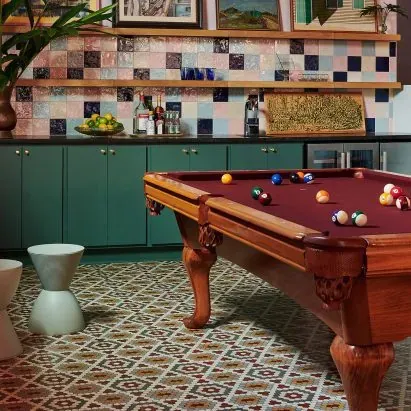
Executive Summary
This guide details moisture resistance, structural load, and lifecycle cost optimization for hotel billiard lounges.
Spatial Philosophy & Architectural Narrative
In modern luxury hospitality interior planning, the entertainment lounge has evolved from a secondary amenity into a key social anchor and visual focal point. Designing these spaces requires a rigorous architectural hierarchy centered around the billiard table. Circulation planning dictates a minimum clearance zone of 1.5 meters from the outer cushion edge to any wall, structural column, or adjacent FF&E to prevent cue collision and maintain optimal passenger flow. The lighting scheme utilizes a dual-system approach. High-performance, glare-free linear pendant fixtures suspended directly above the playing surface provide an average illuminance of 300 to 500 lux, with a uniformity ratio exceeding 0.8 to eliminate localized shadows on the cloth. Complementary ambient lighting consists of low-glare, warm-spectrum downlights (CRI 90+, 2700K) that define the spatial boundaries while preserving an intimate hospitality atmosphere. This calculated contrast of focal and ambient lighting enhances the structural presence of the pool table, transforming a recreational element into an elevated, functional spatial statement.
Luxury FF&E Material Engineering & Joinery Breakdown
The longevity and functional precision of premium hospitality entertainment FF&E rest entirely on structural mechanics and rigorous material selection. For a professional-grade billiard table, the undercarriage frame must support a three-piece calibrated Italian slate playing bed, generating a continuous static load of 350 to 450 kg. Consequently, the primary support beams and structural legs must be crafted from high-density American hardwoods (such as ash or white oak) paired with JIS F1-grade (formaldehyde emission <= 0.3 mg/L) moisture-resistant multi-ply plywood cores to resist permanent deflection. Crucial load-bearing joints discard standard wood screws, utilizing high-tensile carbon steel threaded inserts and heavy-duty thru-bolts to disperse dynamic shear stresses and prevent micro-sagging or structural loosening under long-term operational impacts.
To protect perimeter edges from physical degradation, high-impact zones like outer rails and corners are clad in physical vapor deposition (PVD) titanium-coated stainless steel trims. The coating thickness must measure at least 1.5 microns to withstand frequent impact from cue sticks and chemical corrosion from skin oils and sweat. Any adjacent decorative stone or integrated marble counters are reinforced with high-strength epoxy-bonded carbon fiber backing meshes to prevent stress-induced fracturing.
For the playing surface, specifications mandate a premium worsted wool blend certified to ASTM D3884, achieving a Martindale rating of 40,000+ abrasion cycles without structural pilling or localized wear paths. Surrounding upholstered wall panels and banquette seating must comply with the strict BS 7176 Medium Hazard (Crib 5, 5.2 kW heat release) fire safety standards to satisfy international luxury hotel safety codes.
Furthermore, the joints of the three-piece slate are filled with heated natural beeswax and diamond-honed to restrict any vertical deviation to <= 0.1 mm, ensuring a highly linear ball trajectory. The structural feet are equipped with precision micro-threaded heavy-duty leveling adjusters (with 0.1 mm increment sensitivity) to compensate for minor subfloor unevenness and maintain absolute planar alignment across long-term service cycles. To ensure complete dimensional stability, all timber components undergo vacuum kiln drying and are treated with anti-warping stabilizers. Edge banding for adjacent panels is executed using polyurethane reactive (PUR) adhesives, which maintain exceptional mechanical bond strength under high humidity. The metal structural frame is treated with an anti-corrosion powder coat that exceeds 240 hours of salt spray testing under ASTM B117. By combining these metallurgical and timber-processing protocols, the complete assembly achieves a highly stable performance envelope, minimizing localized mechanical drift over continuous commercial use.
Hospitality Operations, Wear Analysis & TCO Model
In high-traffic hospitality lounges, active entertainment FF&E represents an operational risk for asset depreciation. Heavy wear is concentrated on cushion rails, pocket openings, and adjacent lounge tables due to continuous cue strikes, physical impact, beverage condensation, and chemical sanitizers.
To optimize the Total Cost of Ownership (TCO), professional engineering specifications must implement a proactive modular maintenance design. Rail tops should feature independent, field-replaceable solid wood cappings, and pocket liners must utilize high-impact NBR rubber dampeners wrapped in modular full-grain leather sleeves. This allows rapid on-site restoration of wear-prone components without necessitating structural disassembly or complete replacement.
From a CapEx and OpEx financial perspective, allocating a 12% to 15% premium during the procurement phase to upgrade standard lacquers to high-performance dual-component polyurethane (PU) or ultraviolet (UV) cured coatings, while integrating heavy-duty structural hardware, significantly extends the asset’s active service life. This strategic choice delays the major refurbishment cycle from 3 years to 6 or 8 years. As a result, operational maintenance interventions are reduced by 45%, cutting the cumulative 10-year depreciation and repair costs of the lounge by approximately 30%, which directly improves the property owner’s net operating income. Additionally, this structural durability safeguards hotel brand standards, avoiding down-time and loss of service revenue due to out-of-order lounge amenities.
Sunder Engineering Grounding & Subtropical Climate Defense
In the high-humidity environments of the Asia-Pacific subtropical region (where relative humidity regularly ranges from 75% to 85%), managing moisture-induced movement in timber is essential to prevent warping, joint failure, and veneer delamination. During the factory fabrication phase, the wood’s moisture content (MC) must be precision-controlled to a range of 8% to 12% and stabilized in climate-controlled chambers for 72 hours to release internal stresses.
To shield the core substrates from ambient moisture, all concealed panel faces and undersides must receive a dual-sided polyurethane moisture barrier sealer. Edge-banding processes discard standard EVA hot-melt glues, mandating instead polyurethane reactive (PUR) adhesives to ensure a waterproof bond line. Structural joinery should utilize floating tenons and physical expansion tolerances of 1.2 mm to 1.8 mm, accommodating natural volumetric changes without inducing structural stress. Prefabricating modular sub-assemblies under strict factory tolerances cuts on-site installation time by 40%, protecting unsealed timber components from the uncontrolled, high-humidity site conditions of active construction zones.
B2B Material & Inspection Specification Table
To ensure structural integrity and precise playability in luxury hospitality projects, the following technical matrix establishes the procurement and field inspection criteria:
| Component | Specification | Inspection Standard | Tolerance & Criteria |
|---|---|---|---|
| Frame Substrate | JIS F1 moisture-resistant multi-ply plywood, MC 8-12% | JIS A 5908 / CNS 1349 | Formaldehyde ≤ 0.3 mg/L, flatness tolerance ±0.5 mm |
| Slate Playing Bed | 3-piece calibrated Italian slate, thickness ≥ 40 mm, mesh backing | ASTM C170 (Compression) | Joint mismatch ≤ 0.1 mm, levelness tolerance ±0.3 mm/m |
| Billiard Cloth | High-density worsted wool, water/stain-resistant treatment | ASTM D3884 (Abrasion) | Martindale cycles ≥ 40,000, zero surface pilling |
| Metal Trimming | SUS304 stainless steel, PVD titanium coating, thickness ≥ 1.5 μm | ASTM B117 (Salt Spray) | Salt spray test 96 hours zero corrosion, scratch depth 0 mm |
| Pocket Assembly | Full-grain leather integrated with high-density NBR rubber | ISO 17233 / ASTM D1056 | Deflection durability 10,000 cycles zero tearing |
Field inspectors must utilize calibrated laser levels and high-precision feeler gauges to verify slate joint transitions and absolute levelling tolerances, securing optimal long-term dynamic performance.