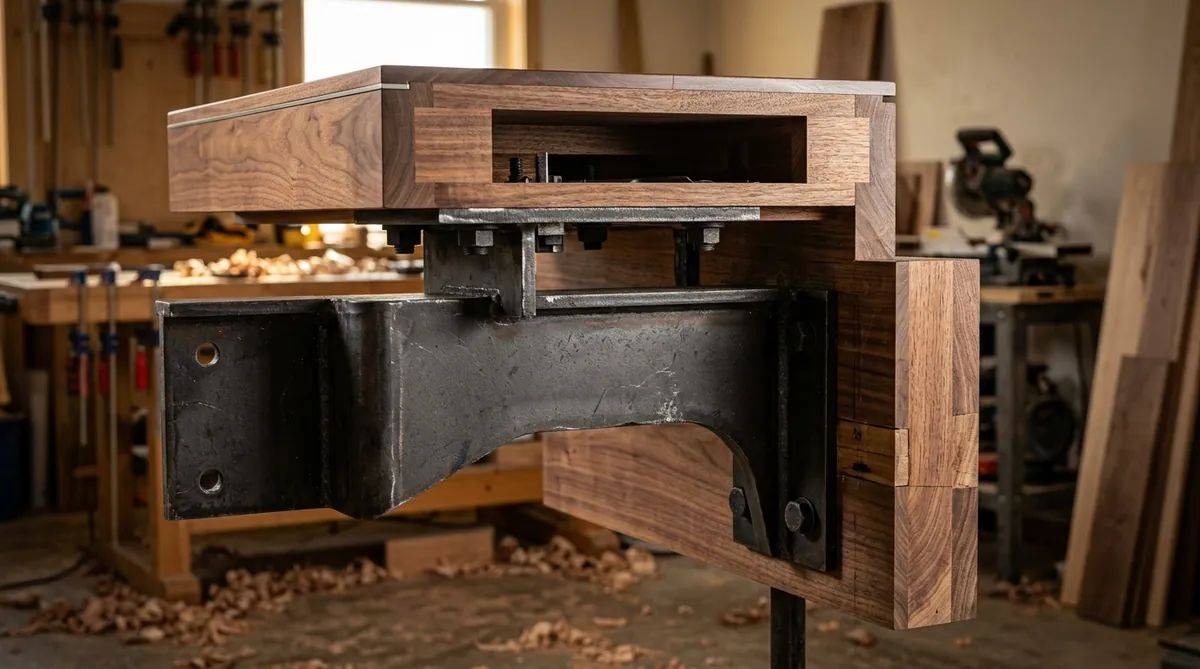
At handover, a three-meter credenza with no intermediate leg looks exactly like the render: straight edge, clean float, no visible support. Somewhere in years two to three, spans over 1,200 mm in timber alone start showing leading-edge droop, and the joints creak before they crack. By year five the sag is usually enough that doors no longer close on their reveal, and the repair is a full unit swap rather than a touch-up. The variable is not the grade of the timber but E and I in the cantilever deflection equation — modulus of elasticity and second moment of area. Timber sits near 10 GPa; structural steel near 206 GPa.
However, in the real physical world of high-turnover commercial environments, these unsupported floating silhouettes subject furniture structures to extreme shear forces, torsional deflection, and bending fatigue. Relying solely on traditional solid timber joinery or dowel-and-mortise connections under heavy dynamic impacts—such as guests dropping luggage or multiple adults seating simultaneously—causes measurable timber fiber creep and joint separation, often within the first two years.
Sunder utilizes B2B Value Engineering (VE) to embed aerospace and architectural-grade Invisible Structural Steel Frameworks beneath ultra-thin veneers, Italian porcelain slabs, or premium leather upholstery. Through data-driven mechanical calculations, we size tube wall and span so that measured leading-edge deflection stays within the value written on the shop drawing.
1. Cantilever Mechanics & Structural Collapse Risks: Bending Moments in Large-Span Timber
In floating, pillar-less furniture, primary mechanical stresses concentrate as Bending Stress and Fixed-End Shear Stress.
+-------------------------------------------------------------------------+
|        Cantilever Furniture Stress Distribution & Long-Term Creep        |
+-------------------------------------------------------------------------+
|  Fixed End / Wall Anchor Interface            Free End / Point Load (F >= 300kg)
|        │                                                │               |
|        ▼ (Max Shear & Bending Moment Zone M_max)        ▼               |
|       ┌──┐═════════════════════════════════════════════┌──┐            |
|       │  │                                             │  │ Deflection δ|
|       │  │─────────────────────────────────────────────│  │ ──► ▼       |
|       └──┘                                             └──┘ (Sagging)   |
|        ▲                                                                |
|        │ (Anchor Pullout Force F_pull = F * L / d)                      |
+-------------------------------------------------------------------------+
According to classic cantilever beam deflection mechanics:
Where:
- is the dynamic external load applied (guest impact weight, luggage loads)
- is the cantilever span length
- is the material Modulus of Elasticity (Solid timber , Structural Steel —a 20.6x stiffness advantage)
- is the Second Moment of Area (Moment of Inertia)
Because solid timber and composite boards possess relatively low elastic moduli and exhibit directional fiber anisotropy, when the span , the cubic span factor () causes exponential sagging. Without internal structural metal reinforcements, leading-edge deflection rapidly exceeds , leading to joint shear rupture and wall anchor pullout.
2. Sunder Invisible Steel Framework: Q235B Cold-Rolled Tubing & Full-Penetration Welding
To achieve structural rigidity without adding external visual bulk, Sunder implements a standardized 4-layer internal armor fabrication specification:
+-------------------------------------------------------------------------+
|     Sunder Invisible Steel 4-Layer Composite Armor (Cross-Section)      |
+-------------------------------------------------------------------------+
|  [Layer 1: Surface Finish]  0.6mm Natural Veneer / 12mm Porcelain Slab  |
|                                |                                        |
|  [Layer 2: Damping Layer]   2.0mm EPDM Micro-Cellular Damping Strip     |
|                                |                                        |
|  [Layer 3: Core Framework]  Q235B Cold-Rolled Seamless Box Section      |
|                             (Wall thickness t >= 2.5mm ~ 3.0mm)         |
|                             + AWS D1.1 Full-Penetration CO2 Arc Welding |
|                                |                                        |
|  [Layer 4: Corrosion Armor] Class-3 Hot-Dip Galvanizing (65 µm)         |
|                             + Electrostatic Thermoset Epoxy Powder Coat |
+-------------------------------------------------------------------------+
1. Structural Steel Metallurgy: Q235B Heavy-Wall Cold-Rolled Box Sections
- Wall Thickness Standard: Primary load-bearing internal members utilize heavy-gauge seamless box sections with wall thickness to , providing tensile strength and yield strength .
- CNC Laser Profile Cutting: Tube ends and structural copings are 3D laser-cut with precision tolerances , ensuring zero-gap weld bevel alignment.
2. Industrial-Grade Full-Penetration CO2 Shielded Arc Welding
- All joints are welded using robotic shielding gas, achieving deep root penetration meeting AWS D1.1 / ISO 5817 Level B structural criteria.
- Post-weld grinding achieves a surface roughness , so overlying veneers bond to a flat substrate without weld-bead telegraphing.
3. All-Weather Corrosion Defense: ASTM B117 1,000-Hour Salt Spray Tested
Internal frames undergo a 3-stage anti-corrosion finishing sequence:
- High-temperature alkaline degreasing and pickling passivation
- Zirconium-based silane conversion nanocoating
- High-temperature electrostatic thermoset epoxy powder coating (film thickness ) This specification is rated for tropical humidity and coastal airborne chlorides after 1,000-hour ASTM B117 salt spray. Parts under continuous sea spray still call for 316 stainless rather than coated Q235B.
3. Timber-to-Steel Differential Expansion Interface & Acoustic Vibration Damping
Because structural steel and timber possess vastly different thermal expansion coefficients () and moisture-induced swelling characteristics (Steel , while timber tangential swelling reaches ), rigid through-bolting creates massive internal shear stresses during climate shifts, causing veneer cracking and creaking noises.
+-------------------------------------------------------------------------+
|            Timber-to-Steel Floating Anti-Creep Expansion Joint           |
+-------------------------------------------------------------------------+
|          [ Outer E0 / JIS F☆☆☆☆ High-Density Hardwood Plywood ]         |
|                                │                                        |
|          [ Embedded Brass Threaded Inserts (M6 / M8 High-Torque) ]      |
|                                │                                        |
|    ┌───────────────────────────▼───────────────────────────┐            |
|    │   2.0mm EPDM Micro-Cellular Anti-Vibration Damping Strip │           |
|    └───────────────────────────┬───────────────────────────┘            |
|                                │                                        |
|          [ Slotted Stress-Relief Expansion Hole in Steel Tube ]         |
|                                │                                        |
|          [ Grade 10.9 Countersunk Flange Bolt + Belleville Washer ]     |
+-------------------------------------------------------------------------+- Slotted Expansion Holes: Precision-milled elongated holes provide of longitudinal slide travel, allowing the outer timber casing to expand naturally without buckling.
- Micro-Cellular EPDM Damping Layer: Continuous flame-retardant EPDM strips are sandwiched between steel and timber substrates, absorbing micro-vibrations and eliminating dry-rub friction noises.
4. Operational ROI: BIFMA X5.5 Proof Testing and Housekeeping OpEx Reductions
Invisible steel frameworks provide measurable, long-term operational advantages across the hotel asset lifecycle:
+-------------------------------------------------------------------------+
|            BIFMA X5.5 Mechanical Proof Test vs. Housekeeping ROI        |
+-------------------------------------------------------------------------+
|  [BIFMA X5.5 Proof Load]    500 kg uniform static load for 24 hours     |
|                             --> Leading-edge deflection <= 1.2mm        |
|                             136 kg dynamic impact drop (100,000 cycles) |
|                             --> Zero joint fracture / zero deformation  |
|                                                                         |
|  [Housekeeping OpEx ROI]    Floating clearance >= 180mm off floor       |
|                             --> 100% straight-line robot / vacuum paths |
|                             --> Room turnaround time reduced by 35%     |
+-------------------------------------------------------------------------+- Safety Margin for Unpredictable Commercial Abuse: Certified under ANSI/BIFMA X5.5 commercial standards to withstand high dynamic loads from luggage, multiple occupants, and edge seating.
- Frictionless Housekeeping Access: Eliminating support legs allows robotic cleaners and housekeeping vacuums to clean unobstructed, saving 3 to 5 minutes per room daily and reducing annual operating expenses OpEx.
5. Total Cost of Ownership (TCO): Traditional Timber Joinery vs. Sunder Invisible Steel
10-Year TCO Evaluation: Traditional Joinery vs. Sunder Steel Armor
| Evaluation Vector | Traditional Timber Joinery | Sunder Invisible Steel |
|---|---|---|
| Max Safe Floating Span | <= 800 mm (Risk of sag) | >= 2,400 mm (Rigid) |
| Proof Load Capacity | Static <= 150 kg (Brittle) | Static >= 500 kg (3.3x) |
| 10-Year Deflection Sag | Cumulative sag >= 12.0 mm | Cumulative sag <= 1.5mm |
| Acoustic Squeak Noise | Dry-friction timber creaks | EPDM isolated, silent |
| Public Liability Risk | High (Sudden joint failure) | Zero structural claims |
| 10-Year Cumulative TCO | Baseline (100% + 2 replacements) | Reduced to 32% |
6. Conclusion: Engineering the Backbone of Luxury Architecture
True luxury in commercial hospitality design is defined by visual lightness with a stated deflection limit behind it. The invisible steel framework embedded inside custom millwork is the true barrier protecting assets from time, heavy traffic, and physical degradation.
Sunder integrates rigorous cantilever deflection mechanics, Q235B heavy-gauge steel, and AWS D1.1 full-penetration welding directly into shop drawings and production lines. Span, load and allowable deflection belong in the specification at shop-drawing stage, not at the first site trial fit. Below 800 mm of span and 150 kg of load, timber joinery alone is usually sufficient and the steel frame only adds cost.
Further Reading
- Hotel Brand Standards & FF&E Compliance Engineering: Marriott, Hilton, and IHG Technical Specifications Unpacked
- Hotel Room Functional Furniture & MEP Integration Engineering: Pre-Routed Wire Management, Thermal Dissipation Channels, and Quick-Release Maintenance in Nightstands, Mini-Bars, and TV Consoles