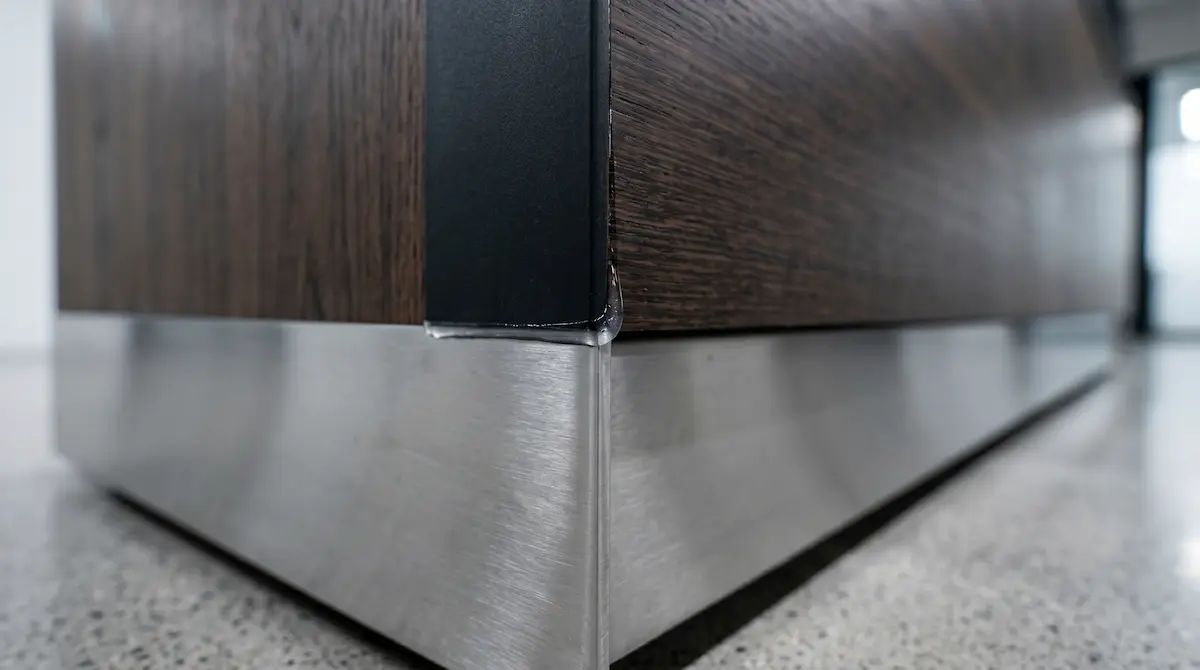
A 30 kg hard-shell suitcase rolling at 1.2 m/s carries roughly 21.6 J of kinetic energy. Land that on the 2 mm² contact patch of a wheel corner and the instantaneous contact stress passes 45 MPa, above what a 0.3 mm paper foil tape and the substrate beneath it will absorb. That is the real load case for guestroom entryways, luggage benches and casework plinths, and it is why thin banding chips within the first 1 to 3 months of operation. Once the tape splits, mop water follows the capillary path into the core and the failure stops being cosmetic. The rest of this article turns that path into numbers a specification can hold: banding thickness, glue line, radius, and the test method that verifies each one.
When guests roll heavy aluminum-magnesium hard-shell suitcases through entry alcoves or housekeeping crews maneuver metal cleaning carts around sharp corners, furniture perimeters face severe mechanical impacts from sharp metal corners and caster wheels. If procurement specifications permit conventional residential paper foil or thin wood tape edge banding, corners fracture, chip, and expose raw substrate within 1 to 3 months. Once edges crack, mop water and ambient humidity penetrate porous timber cores, triggering swelling, rot, and complete casework failure.
Sunder integrates B2B Value Engineering (VE) and Layered Armored Engineering through kinetic impact modeling, 2.0mm heavy-duty ABS banding, and waterproof PUR zero-glue-line hot-melt technology, writing the edge condition into specifications a third party can test.
1. Luggage Kinetic Impact Mechanics & Edge Shear Concentration
In classical mechanics, high-velocity mass concentrated across a microscopic contact patch generates high instantaneous contact stresses:
+-------------------------------------------------------------------------+
|            Luggage Wheel Corner Impact Stress Penetration Model         |
+-------------------------------------------------------------------------+
|  [30kg Hard-Shell Suitcase (Velocity v = 1.2 m/s)]                      |
|        │                                                                |
|        ├──► Kinetic Impact Energy E_k ≈ 21.6 J                          |
|        │                                                                |
|        └──► Concentrated onto 2mm² wheel corner ──► Stress > 45 MPa     |
|                 │                                                       |
|       ┌─────────▼──────────────────────────┐                            |
|       │ 【Conventional 0.3mm Paper Tape】  │                            |
|       │  Zero shock absorption ──► Chipping│                            |
|       │  Substrate exposed ──► Moisture rot│                            |
|       └────────────────────────────────────┘                            |
|                 │                                                       |
|       ┌─────────▼──────────────────────────┐                            |
|       │ 【Sunder 2.0mm ABS + PUR Armor】   │                            |
|       │  Elastic dissipation ──► Stress diluted by R3 radius to <= 8 MPa|
|       │  PUR hot-melt seal ──► 100% waterproof barrier (Zero swelling)  |
|       └────────────────────────────────────┘                            |
+-------------------------------------------------------------------------+
2. Sunder 4-Tier Impact Hotspot Armored Hierarchy
Sunder standardizes layered armor protection across the three highest-risk impact zones:
+-------------------------------------------------------------------------+
|        Sunder 4-Tier Armored Edge Cross-Section (Cross-Section)         |
+-------------------------------------------------------------------------+
|  [Layer 1: Heavy Armor]      2.0mm Industrial High-Impact ABS Banding   |
|                              (Notched Izod Impact Strength >= 35 kJ/m²) |
|                                │                                        |
|  [Layer 2: Zero-Glue Line]   German Reactive PUR Hot-Melt (< 0.1mm Line)|
|                                │                                        |
|  [Layer 3: Stress Relief]    CNC Machined Precision R3.0mm Radius Bevel |
|                                │                                        |
|  [Layer 4: Base Plinth Armor]30cm Anodized Aluminum / 8mm Compact Board |
+-------------------------------------------------------------------------+
1. 2.0mm Heavy-Duty Industrial ABS Edge Banding
- Replaces brittle PVC and thin paper foils. ABS provides high impact toughness with notched impact strength .
- Deforms elastically to absorb the shock and rebounds, which lowers the rate of permanent denting and edge chipping.
2. German PUR Reactive Hot-Melt Waterproof Sealing
- Utilizes reactive Polyurethane (PUR) hot-melt adhesives that chemically cross-link with airborne moisture to form an irreversible high-density bondline.
- Calibrated to achieve an invisible glue line , resisting thermal cycling from to and showing no delamination after 72 hours of water immersion.
3. R3.0mm CNC Stress-Relief Radius Beveling
- All exposed convex corners are 5-axis CNC profiled with a smooth radius, reducing sharp edge stress concentration factors by .
4. 30cm Base Plinth Anodized Aluminum & Compact Laminate Armor
- Entryway plinths, luggage rack aprons, and corridor corners incorporate anodized aluminum or heavy-density Compact Laminate, keeping housekeeping cart contact off the substrate.
3. ASTM Mechanical Impact & Adhesion Compliance Matrix
Armored Edge Engineering Quality Acceptance Matrix
| Inspection Vector | Testing Standard | Sunder Passing Spec |
|---|---|---|
| Falling Dart Impact | ASTM D2794 (1kg from 1m) | Impact Energy >= 10 J |
| Edge Peel Strength | EN 311 Tensile Peel Test | Peel Force >= 100 N/cm |
| Steam & Waterproof | DIN 68861/1 Boiling Vapor | >= 72 Hours No Swelling |
| Abrasion Resistance | ASTM D4060 Taber (CS-10) | 5,000 Cycles Zero Gouge |
| Thermal Shock Adhes. | ISO 9142 Temperature Cycle | -40°C ~ 120°C No Creep |
4. Zero Moisture Infiltration & Housekeeping OpEx Elimination
Armored edge detailing closes the two routes moisture normally takes into the core:
+-------------------------------------------------------------------------+
|          Armored Detailing vs. Housekeeping & Asset Preservation        |
+-------------------------------------------------------------------------+
|  [Zero Moisture Path]   PUR zero-glue-line ➔ Blocks mop water & alcohol |
|                         --> Core board swelling strictly <= 8%          |
|                                                                         |
|  [Cart Maneuverability] 30cm Aluminum plinth armor ➔ Housekeeping carts |
|                         operate freely without fear of damaging bases   |
|                                                                         |
|  [Zero Field Patching]  2.0mm ABS toughness ➔ Eliminates putty / paint  |
|                         touch-up labor and associated room downtime     |
+-------------------------------------------------------------------------+
5. Total Cost of Ownership (TCO): Fragile Tape vs. Sunder Armored Engineering
10-Year TCO Evaluation: Conventional Edge Tape vs. Sunder Armor
| Evaluation Vector | 0.3mm Paper / Thin Foil | Sunder 2.0mm ABS/PUR |
|---|---|---|
| Luggage Impact Life | Chips in 1 to 3 months | 10 Years Zero Chipping |
| Adhesive Water Resistance | EVA Glue (Peels when damp) | PUR Reactive (0% Rot) |
| Core Swelling Rate | 25% ~ 35% Rooms Swelled | 0% Moisture Swelling |
| Annual Touch-Up Costs | High (Carpenters re-banding) | Zero Maintenance Fee |
| Chipped Edge Reviews | 3% ~ 5% Guest Complaints | 0 Edge Complaints |
| 10-Year Cumulative TCO | Baseline (100% + Scrap) | Reduced to 33% (-67%) |
6. Conclusion: Fortifying the Most Vulnerable Architectural Boundaries
In luxury hotel asset preservation, casework durability is dictated not by the strongest component, but by the resilience of its most vulnerable edges. A single chipped corner is the initiation point for moisture swelling, fungal decay, and premature asset write-offs.
Sunder enforces 2.0mm heavy-duty ABS banding, German PUR hot-melt fusion, and R3 stress-dispersion profiling across all impact zones. This addresses mechanical impact from luggage and carts. Where the dominant wear mode is UV exposure or alkaline cleaning chemistry, the fix belongs in the coating and the substrate, not the banding. Ask for the ASTM D2794 and EN 311 reports rather than a stated tape thickness.