FF&E — furniture, fixtures and equipment — is one of the five budget categories in the HVS hotel development cost survey, beside land, construction, soft costs and pre-opening capital, and is carried as its own capital line (CapEx); its share moves with star rating, brand standards and whether MEP is counted, so no single percentage holds. The failures cluster into a narrow window: the two weeks the furniture arrives on site. Casework that will not meet the wall, white-body construction that does not match the shop drawing, sea-freight moisture damage — all of it surfaces on site, and by then there is no schedule left to remake anything. What follows breaks procurement into five checkpoints, each with what to inspect and which document to keep.
However, in conventional hospitality construction and procurement workflows, structural building tolerances, detached shop drawings, ambiguous factory acceptance criteria, and inadequate transport packaging frequently lead to severe site issues: furniture failing to fit alcoves, destructive on-site saw cuts destroying edge seals, uninspected internal structural defects, maritime moisture and mold infestation, and rapid hardware failure within the first year of operation. This results in millions of dollars in project handover delays and claims, transforming the operating phase into an uncontrollable OpEx liability.
Sunder establishes a standardized FF&E procurement and quality verification Standard Operating Procedure (SOP) incorporating 5 Core Verification Gates driven by B2B Value Engineering (VE) and total asset lifecycle management.
1. 5-Stage Full Lifecycle FF&E Procurement & Verification Engineering Roadmap
+-------------------------------------------------------------------------+
|        Sunder FF&E Hotel Furniture 5-Stage Verification Gates (SOP)     |
+-------------------------------------------------------------------------+
|  [Stage 1: Shop Drawings & Survey]   --> 3D Laser Point-Cloud Scan +    |
|                                          Tolerance Engineering (+/-0.5mm)|
|                                │                                        |
|  [Stage 2: 1:1 Mock-Up Room Audit]   --> On-Site Ergonomics, Clearances |
|                                          & Destructive Stress Testing   |
|                                │                                        |
|  [Stage 3: Factory White Body FAT]   --> Unpainted Joinery, Tenon Pull- |
|                                          Out (>=3.5kN), EMC Moisture QC |
|                                │                                        |
|  [Stage 4: ISTA 3A Transit Testing]  --> Drop & Vibration Proofing +    |
|                                          CBM Optimization + Sealed Film |
|                                │                                        |
|  [Stage 5: On-Site TCO Acceptance]   --> PUR Edge-Banding QC, Acoustic  |
|                                          Hardware Test (<=25dB), Handover|
+-------------------------------------------------------------------------+
2. Stage 1: Shop Drawing Deepening, 3D Laser Point-Cloud Survey & Tolerance Buffers
Interior design construction drawings typically represent idealized geometric dimensions. In real building structures, reinforced concrete (RC) shear walls exhibit verticality deviations (often ), while floor slabs and plaster thicknesses show significant dimensional variance.
+-------------------------------------------------------------------------+
|            Structural Wall Tolerances & Furniture Shadow Gap Interface  |
+-------------------------------------------------------------------------+
|  [Reinforced Concrete Structural Wall (Tilt Deviation +/-10mm)]         |
|       │                                                                 |
|       ├── 15mm Shadow Gap / Micro-Adjustable Subframe Buffer            |
|       │                                                                 |
|       └── [Factory Prefabricated Guestroom Millwork] (CNC +/-0.5mm)     |
|                 │                                                       |
|                 └── Concealed Heavy-Duty Levelers (Adjustable +/-15mm)  |
+-------------------------------------------------------------------------+- 3D Spatial Laser Point-Cloud Scanning: Prior to manufacturing, high-precision LiDAR scans are conducted across guestroom headboard walls, entry wardrobes, and vanity alcoves to absorb structural deviations directly in factory production drawings.
- Shadow Gap Integration: All large fixed millwork units incorporate pre-engineered shadow gaps and micro-adjustable subframes, strictly prohibiting destructive on-site saw modifications.
3. Stage 2: 1:1 Full-Scale Mock-Up Room Verification
The mock-up room is the mandatory physical gate for validating aesthetics, ergonomics, operational housekeeping, and mechanical durability prior to mass production:
+-------------------------------------------------------------------------+
|               Mock-Up Room 4 Core Operational Verification Vectors      |
+-------------------------------------------------------------------------+
|  [1. Housekeeping Clearances]  --> Base elevation >= 15cm for robots &  |
|                                    vacuums (100% straight-line access)  |
|  [2. MEP & Cable Compatibility]--> Bedside faceplates align flush with   |
|                                    zero cable bend stress or light leaks|
|  [3. Chemical Wipe Resistance] --> 100 wipes with 75% ethanol / bleach   |
|                                    with zero surface hazing or softening|
|  [4. Dynamic Fatigue Proofing] --> 5,000 cyclic 100kg impact cycles on  |
|                                    sofa cushions with zero sagging      |
+-------------------------------------------------------------------------+
Mock-up room sign-off requires the four-party execution of the “Golden Sample Acceptance Protocol” by the Hotel Owner, Brand Standards Inspector, Interior Architect, and Sunder Lead Engineer, serving as the benchmark for mass production.
4. Stage 3: Factory White Body FAT (Hidden Joinery Inspection)
Once topcoats and veneers are applied, internal structural defects become invisible. Therefore, Sunder’s SOP mandates a Factory Acceptance Test (FAT) on unpainted White Bodies:
Factory White Body FAT Hidden Structure Inspection Specs
| Inspection Vector | Testing Standard & Tooling | Passing Benchmark |
|---|---|---|
| Timber Moisture | Pin-Type Microwave Meter | Strictly 8% ~ 10% EMC |
| Frame Joinery | Double Dowels + Corner Blocks | Pull-Out >= 3.5 kN |
| Formaldehyde Emiss. | Environmental Test Chamber | JIS F☆☆☆☆ (≤0.3 mg/L) |
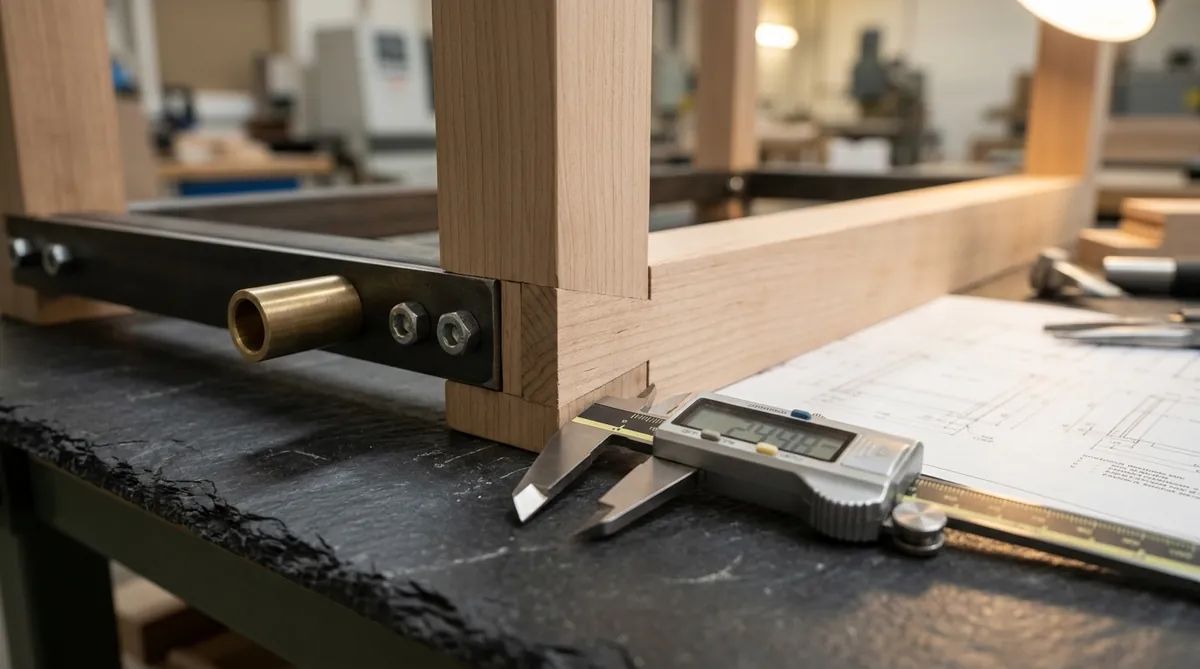
| Internal Steel Spec | Vernier Caliper Thickness | Q235B Wall t >= 2.5mm |
| Cable Chases | Tactile & Mirror Scope | R3mm Edge + Grommets |
5. Stage 4: CBM Optimization & ISTA 3A International Transit Drop Proofing
Maritime container shipping and inland trucking represent high-risk vectors for structural cracking and saltwater vapor damage.
+-------------------------------------------------------------------------+
|         ISTA 3A Heavy-Duty Multi-Layer Packaging Cross-Section          |
+-------------------------------------------------------------------------+
|  [Outer Shell] 7-Ply Heavy-Duty Double-Wall Corrugated Carton (1800 kPa)|
|                                │                                        |
|  [Edge Armor]  5.0mm Heavy-Density L-Shaped Paperboard Edge Protectors  |
|                                │                                        |
|  [Foam Buffer] 20mm High-Density EPS / EPP Shock-Absorbing Foam (6 sides)
|                                │                                        |
|  [Vapor Seal]  Full Heat-Shrink Polyethylene Film + Desiccant Packs     |
+-------------------------------------------------------------------------+- ISTA 3A Drop Proofing: Cartons undergo 10 free-fall drop tests from (1 corner, 3 edges, 6 faces) with zero internal component damage.
- CBM Optimization: Knock-down modular engineering increases 40HQ container volumetric capacity by , significantly reducing landed logistics costs.
6. Stage 5: On-Site Acceptance & 10-Year TCO Asset Protocol
Upon installation completion, final verification checklists are executed:
- Infrared PUR Edge Sealing Audit: Verify all underside and perimeter edges feature waterproof PUR hot-melt edge-banding with zero adhesive overflow (glue line ).
- Acoustic Hardware Verification: Measure door and drawer closing sound levels with precision sound meters ().
- Digital Asset Archive Delivery: Provide complete CAD as-built drawings, spare parts inventory lists, maintenance manuals, and a formal 5-year structural warranty agreement.
7. Total Cost of Ownership (TCO): Unregulated Procurement vs. Sunder Standardized SOP
10-Year TCO Evaluation: Traditional Procurement vs. Sunder SOP System
| Evaluation Vector | Unregulated Spot Procurement | Sunder FF&E SOP |
|---|---|---|
| Site Dimensional Errors | 8% ~ 12% Units Modified | 3D Laser Scan (0%) |
| Internal Joinery Spec | No White Body FAT (Unchecked) | 100% FAT Tested |
| Transit Damage Rate | Standard Carton (3% ~ 5% Dam.) | ISTA 3A (0.1%) |
| Handover Delay Risk | High (Rework delays opening) | Zero Delay Record |
| 10-Year Cumulative TCO | Baseline (100% + Claims) | Reduced to 38% |
8. Conclusion: Transforming Procurement Uncertainty into Institutional Certainty
In large-scale hospitality developments, institutional quality is never an accident of luck; it is the direct result of disciplined engineering governance and non-negotiable verification SOPs.
Sunder integrates 3D laser scanning, mock-up room verification, white-body FAT inspections, and ISTA 3A packaging defense into every phase of FF&E procurement. By eliminating hidden site risks, we ensure multi-million-dollar hospitality investments are delivered on time, within budget, and with enduring institutional asset durability.