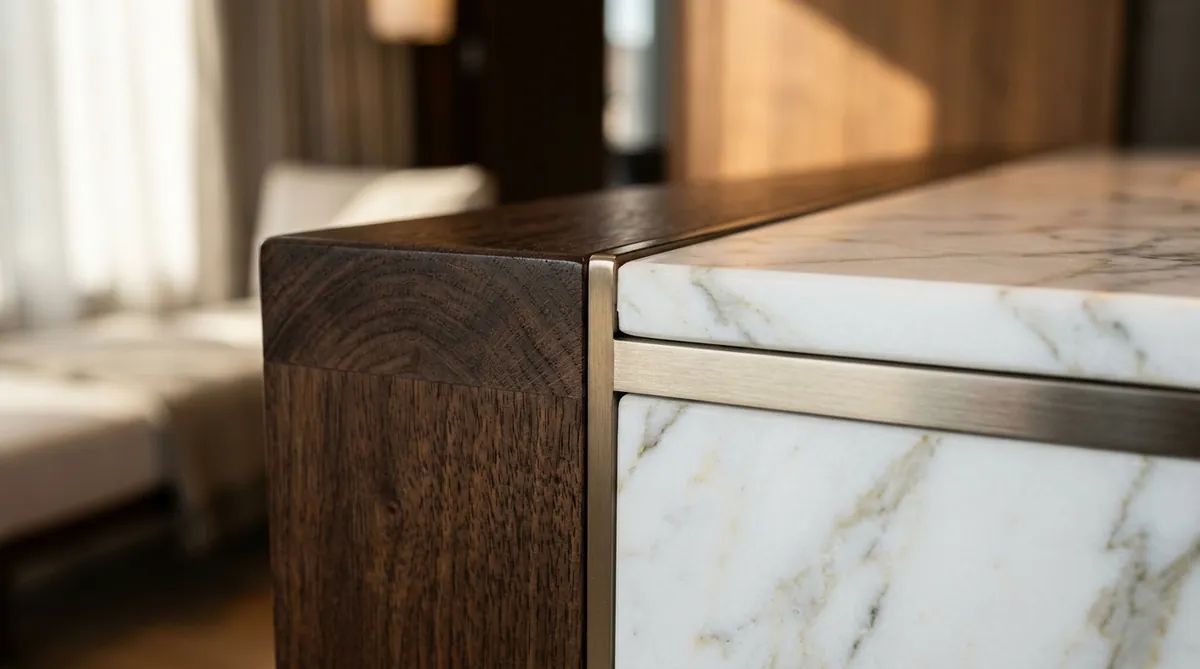
Martindale at 50,000 cycles is an abrasion number for a hide’s surface; it says nothing about the plastic deformation a seat takes at one loading point. ASTM C615 covers stain resistance in stone, 1,000-hour neutral salt spray covers corrosion in metal, and neither addresses what daily hypochlorite wiping does to a plated finish. No single report covers the ageing of one unit that combines Grade-304 stainless, marble, full-grain leather and hardwood. The four decay at different rates, and the rigid seams between them open as they expand and contract out of step. The specifications below are written against that difference in rate.
However, commercial high-turnover hospitality environments subject multi-material assemblies to severe physical and chemical stresses: electroplated metal trims oxidize and show fingerprints, unsealed marble capillaries absorb wine and coffee within minutes causing permanent yellow staining, leather cushions sag and wrinkle under repetitive seating loads, and material interfaces rupture under HVAC climate cycling.
Sunder deconstructs the four core engineering pillars of luxury hotel multi-material craftsmanship through B2B Value Engineering (VE) and materials physics defense.
1. Metal Engineering: PVD Physical Vapor Deposition & Oleophobic Anti-Fingerprint Nanocoatings
Traditional electroplating or liquid-spray metal finishes degrade rapidly under commercial housekeeping protocols using hypochlorite, alcohol, or alkaline cleaning detergents, peeling or tarnishing within 6 to 12 months.
+-------------------------------------------------------------------------+
|                PVD Vacuum Ion Deposition 3-Layer Metal Armor            |
+-------------------------------------------------------------------------+
|  [Layer 1: Oleophobic Topcoat]  AF (Anti-Fingerprint) Nanocoating       |
|                                 (Water Contact Angle >= 110°)           |
|                                │                                        |
|  [Layer 2: PVD Ion Coating]     Titanium Nitride Vapor Deposition       |
|                                 (Film 1.5-2.5µm, Hardness HV >= 2200)   |
|                                │                                        |
|  [Layer 3: Structural Metal]    Austenitic Grade-304/316 Stainless Steel|
|                                 (Tensile Strength >= 520 MPa)           |
+-------------------------------------------------------------------------+
1. PVD Physical Vapor Deposition
- In a high-vacuum plasma chamber, high-purity titanium metal is vaporized and deposited as ionized atoms onto Grade-304 stainless steel, forming a dense crystal layer.
- Surface Vickers hardness reaches (3 times harder than conventional chrome plating), certified under ASTM D3363 9H pencil hardness and 1,000-hour neutral salt spray testing to resist luggage cart impacts and key scratches.
2. AF (Anti-Fingerprint) Oleophobic Nanocoating
- Evaporation-deposited fluorocarbon nano-molecules achieve a water droplet contact angle and oil contact angle .
- Fingerprints wipe off with a dry microfiber cloth instead of a solvent cleaner, which lowers chemical consumption. The AF layer is sacrificial; on high-touch edges expect to reapply it at refurbishment.
2. Stone Engineering: 6-Sided Vacuum Pressurized Nano-Sealing for Natural Marble
Natural marble (such as Bianco Carrara, Calacatta, and Nero Marquina) contains vast networks of microscopic capillaries (Porosity ). When red wine, espresso, tea, or acidic cosmetics spill on untreated stone, liquids penetrate 3mm deep within 15 minutes, causing indelible sub-surface yellow discoloration.
+-------------------------------------------------------------------------+
|     6-Sided Vacuum Pressurized Nano-Sealing for Natural Marble          |
+-------------------------------------------------------------------------+
|  Spilled Liquids (Wine/Coffee) ──► Repelled by fluoro-silane barrier,  |
|                                    beading on surface (Zero stain >= 24h)
|  ─────────────────────────────────────────────────────────────────────  |
|  [Micro-Pores (3-5mm deep)]    ──► Vacuum-infused fluoro-silane polymer |
|                                    nanocores (Breathable, hydrophobic)  |
|  ─────────────────────────────────────────────────────────────────────  |
|  [Natural Marble Core]         ──► Preserves organic cool tactile feel   |
|                                    (Zero plastic resin surface coating) |
|  ─────────────────────────────────────────────────────────────────────  |
|  [Carbon-Fiber Underside]      ──► 200g/m² Carbon Fiber Mesh + Epoxy    |
+-------------------------------------------------------------------------+- Vacuum Infusion Process: Following CNC fabrication, stone slabs enter vacuum impregnation autoclaves where negative pressure drives fluorosilane nano-sealants deep into natural pores.
- Stain Resistance Standard: Conforms to ASTM C615 stain resistance criteria, providing of zero-penetration protection against hot coffee, citrus acids, and red wine.
- Carbon-Fiber Underside Armor: Slabs receive a continuous biaxial carbon-fiber backing bonded with high-tensile epoxy, raising flexural strength by and reducing the risk of cracking on unsupported overhangs.
3. Leather Craftsmanship: Full-Grain Leather Anti-Fatigue Aramid Backing
Commercial desk chairs, footstools, and sofa armrests upholstered with low-grade split leather or unsupported hides typically show surface cracking, stretch and sag inside 12 months of commercial use.
+-------------------------------------------------------------------------+
|         4-Layer Luxury Leather Anti-Fatigue & Suspension System         |
+-------------------------------------------------------------------------+
|  [Layer 1: Surface Leather] 1.2-1.4mm Full-Grain Semi-Aniline Calfskin  |
|                                │                                        |
|  [Layer 2: Anti-Sag Backing] 300g/m² High-Tensile Aramid Composite Felt|
|                                │                                        |
|  [Layer 3: Resilience Core]  >= 45 kg/m³ Cold-Molded HR Foam (High-ILD) |
|                                │                                        |
|  [Layer 4: Spring System]    9-Gauge High-Carbon Steel Sinuous Springs  |
+-------------------------------------------------------------------------+- EU-Certified Full-Grain Semi-Aniline Leather: Preserves natural hide breathability while applying a microscopic waterborne polyurethane abrasion shield, certified for 50,000 Martindale cycles and ISO 11640 color fastness Grade 4.5.
- Aramid Fiber Anti-Sag Backing (300 g/m²): Thermally fused to the leather underside, this high-tensile composite backing slows the plastic stretching caused by repetitive point loading. The five-year figure assumes guestroom-level use; banquet and lounge seating turns over far faster and should be inspected annually.
4. 4-Material Intersecting Joints: 1.5mm Shadow Stress-Relief Expansion Gaps
When stainless steel, natural marble, full-grain leather, and hardwood millwork meet at a single architectural juncture (e.g., an executive desk corner), Sunder engineers a Micro-Expansion Joint:
+-------------------------------------------------------------------------+
|           4-Material Intersection Stress-Relief Joint (Node Detail)      |
+-------------------------------------------------------------------------+
|             [ Natural Marble Top ]       [ PVD Grade-304 Metal Trim ]   |
|                       │                                │                |
|       ┌───────────────▼────────────────────────────────▼───────────────┐|
|       │ 1.5mm Beveled Shadow Gap (Neutral Weatherproof Silicone Seal)  │|
|       └───────────────┬────────────────────────────────┬───────────────┘|
|                       │                                │                |
|             [ Full-Grain Leather Wrap ]  [ E0 JIS F☆☆☆☆ Hardwood Base ] |
+-------------------------------------------------------------------------+- Geometric Stress Decoupling: Seams feature a shadow line with micro-beveled edges, taking up differential thermal movement between the four materials.
- Resilient Polymer Adhesion: Utilizing Modified Silane (MS) polymer adhesives ( elongation at break) permits microscopic flex before the bondline is loaded.
5. Total Cost of Ownership (TCO): Conventional Craft vs. Sunder Multi-Material Engineering
10-Year TCO Matrix: Conventional Fabrication vs. Sunder Engineering
| Evaluation Vector | Conventional Assembly | Sunder Engineering |
|---|---|---|
| Metal Surface Wear | Electroplate (HV 600, Rust) | PVD Coating (HV ≥ 2200) |
| Fingerprint Smudges | Raw finish, daily polish | AF Nanocoat (Wipe-clean) |
| Marble Stain Barrier | Surface wax (< 15 min seal) | Vacuum Nano (≥ 24 hrs) |
| Leather Cushion Sag | Standard foam (Sags in 1yr) | HR 45kg/m³ + Aramid |
| Material Seam Lifespan | Rigid lock (Cracks in 6mo) | 1.5mm Shadow Gap (10yr) |
| 10-Year Cumulative TCO | Baseline (100%) | Reduced to 34% (-66%) |
6. Conclusion: Engineering Details to Endure Commercial Hospitality
In five-star luxury hotels, true bespoke quality is not achieved through unguided material extravagance, but through the seamless convergence of materials science, chemical barrier engineering, and high-precision mechanical joinery.
Sunder standardizes PVD vacuum deposition, 6-sided marble vacuum infusion, aramid-backed full-grain leather, and micro-expansion decoupling directly on production lines. One scope note: PVD and deep nano-sealing pay back where turnover is high, in guestrooms and public areas. In low-use private suites, conventional plating with a scheduled wax cycle usually costs less over the same ten years.