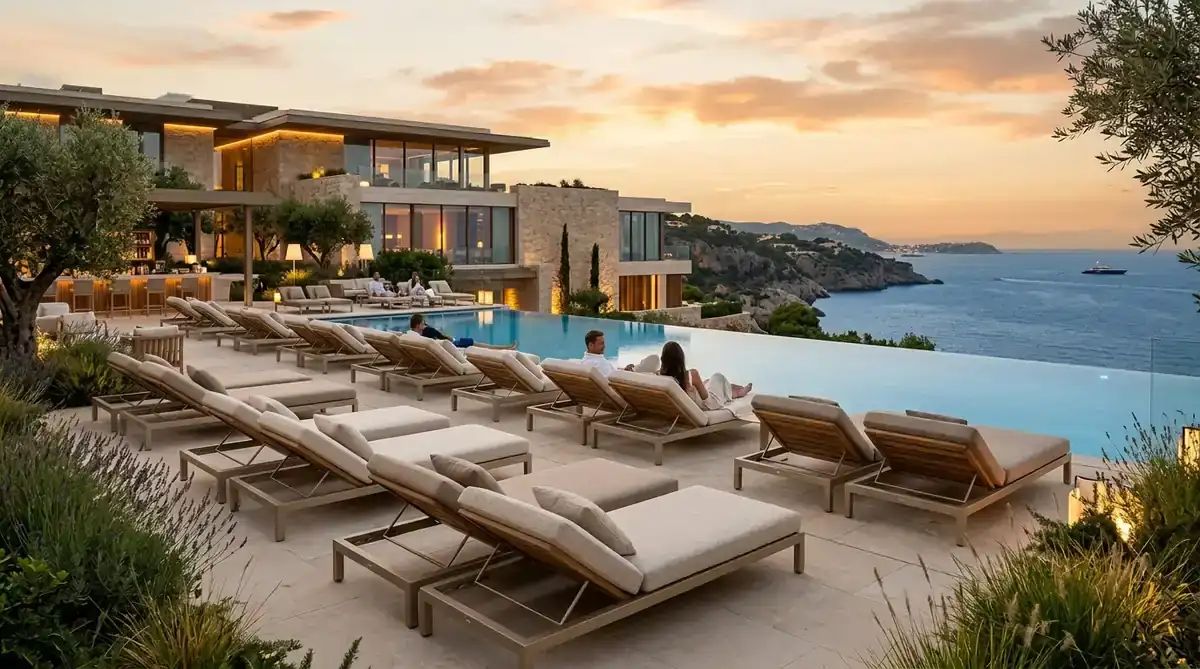
In month nine, an orange bloom appears at the foot of a poolside lounger and runs 15 cm down the pale travertine deck. It is not surface dirt: 201 or 304 tube pits from the inside in chloride-laden air, the rust weeps out through weld seams and fastener holes, and once it wicks into the capillaries of the stone, grinding 2 mm deep still leaves a tonal shadow. On the same terrace the cushions have taken on water and are blooming black inside, and the synthetic wicker has photodegraded to the point where a guest’s weight snaps a strand. Three unrelated failures, one shared cause: the specification was written for residential outdoor use.
In maritime coastal environments, ambient air carries high concentrations of chloride ions (), extreme solar ultraviolet radiation (), and severe thermal humidity cycles (). When developers specify standard residential outdoor furniture, the failure sequence typically runs over 6 to 12 months: 201/304 steel tubes perforate internally, weeping red rust stains onto expensive natural marble paving; synthetic wicker photodegrades and snaps; and closed-cell cushions absorb water, blooming with mold and mildew. This triggers severe guest complaints, compensation claims, and compounding OpEx replacement drains.
Sunder integrates B2B Value Engineering (VE) and Marine Metallurgical Chemistry, deploying 316L marine-grade stainless steel, ASTM B117 1,000-hour salt spray PVDF fluoropolymer finishes, Sunbrella solution-dyed acrylics, and QuickDry reticulated foam so that the corrosion, coating, and colourfastness claims each rest on a test report rather than a description.
1. Chloride Pitting Corrosion Kinetics & Pitting Resistance Equivalent Number (PREN) Model
In marine atmospheric environments, the resistance of stainless steel alloys to chloride pitting is determined by chemical metallurgy:
+-------------------------------------------------------------------------+
|     Coastal Marine Corrosion Depth: 201/304 vs. Sunder 316L Marine Steel|
+-------------------------------------------------------------------------+
|  Pitting Depth (µm)                                                     |
|    ▲                                                                    |
| 300│                                    / [Conventional 201/304 Steel]  |
|    │                                   /  (PREN < 19 ➔ Red rust in 6 mo)|
| 200│                                  /   (Perforates & structural snap)|
|    │ ─────────────────────────────────     [Allowable Safety Cap 50 µm] |
|  50│                                                                    |
|    │   [Sunder 316L Marine + PVDF] ════════════════════════════════════ |
|    │  (PREN >= 25.5 + 1000h Salt Spray ➔ 10-Year Zero Rust / 0 Perforate|
|   0└──┴──────────────────────────┴──────────────────────────► Time (Yrs)|
|        0 (Opening)              2 (Year 2)                  5 (Year 5)  |
+-------------------------------------------------------------------------+
+-------------------------------------------------------------------------+
| Extreme Outdoor Upholstery 4-Tier Drainage & Anti-UV Cross-Section |
+-------------------------------------------------------------------------+
| [Outer Skin]: Sunbrella Solution-Dyed Acrylic (UV injected, 2000h 4-5) |
| ┌─────────────────────────────────────────────────────────────────┐ |
| │ │ |
| │ [Core]: QuickDry Reticulated Polyurethane Foam (90% open pores) │ |
| │ (Rainwater passes through instantly, dry in 30 minutes)│ |
| │ │ |
| ├─────────────────────────────────────────────────────────────────┤ |
| │ [Substrate]: French Batyline open-mesh base + 316L hardware │ |
| └─────────────────────────────────────────────────────────────────┘ |
+-------------------------------------------------------------------------+2. 4 Core Coastal Extreme Climate Outdoor Engineering Standards
Sunder standardizes marine environmental resilience across every structural interface:
1. 316L Marine-Grade Stainless Steel & Electropolishing
- For properties within 5 km of the ocean, all exposed metal framing and fasteners specify 316L marine-grade austenitic stainless steel (). Molybdenum makes the chromium-rich passive film harder to break down locally in chloride environments, which delays pit initiation. It delays it; it does not make the alloy immune.
2. 6061-T6 Structural Aluminum + Triple-Coat PVDF Fluoropolymer Coating
- Lightweight lounger subframes utilize 6061-T6 aerospace aluminum pre-treated with chromate conversion and finished with Kynar 500 PVDF fluoropolymer coatings (film thickness ).
- Coatings are tested under ASTM B117 1,000-hour continuous neutral salt spray (NSS), with the report recording no blistering and no film delamination.
3. Sunbrella Solution-Dyed Acrylic Textiles (Anti-UV Color Lock)
- Replaces piece-dyed fabrics with solution-dyed acrylic fibers where UV-resistant pigments are infused during molten polymer spinning.
- Certified under AATCC 169 Xenon-Arc 2,000-hour accelerated weathering (Grade 4-5 colorfastness). Read that number for what it is: 2,000 hours is accelerated exposure, not calendar years, and irradiance on an exposed tropical terrace runs above the temperate reference condition, so convert conservatively.
4. QuickDry Reticulated Open-Cell Polyurethane Foam (30-Min Dry Time)
- Cushions deploy 90% open-cell reticulated polyurethane foam. Water passes straight through within seconds, while antimicrobial additives slow the mildew growth that closed-cell foam traps.
3. Actuarial Quantification: Beachfront Resort Outdoor FF&E 10-Year Model
The table below is a modelled scenario, not measured history: 150 outdoor sets, a 10-year hold, standard-grade units priced at roughly 60% of the engineered spec, a 2-year replacement cycle on the standard side, and paving repair and guest-claim costs estimated from past projects. Change the replacement cycle and the conclusion changes with it.
Beachfront Resort Outdoor FF&E 10-Year Financial & TCO Actuary
| Actuarial Parameter | Standard Residential | Sunder Marine VE |
|---|---|---|
| First Signs of Rust & Snapping | Months 8 to 12 | 10+ Years Stable |
| 10-Year Replacement Frequency | 4 Cycles (Every 2 Yrs) | 0 Cycles (10y+) |
| 10-Year FF&E Capital Outlay | NT$ 24,000,000 | NT$ 9,500,000 |
| Rust Staining Marble Paving Rpr | NT$ 3,600,000 | NT$ 0 (Zero Rust) |
| Wet Cushion Guest Claims | NT$ 1,500,000 | NT$ 0 (30-Min) |
| 10-Year Cumulative TCO Outlay | NT$ 29,100,000 | NT$ 9,500,000 |
| 10-Year True Net Financial Gain | Severe Capital Drain | +NT$ 19,600,000 |
Under those assumptions the standard-grade path accumulates about NTD 29,100,000 over 10 years against NTD 9,500,000 for the engineered spec, a gap close to NTD 20,000,000. Almost all of it comes from replacement frequency. A site more than 5 km inland, or one that stores cushions and loungers through the off-season, will see that gap narrow sharply.
4. Total Cost of Ownership (TCO): Standard Outdoor vs. Sunder Marine Engineering
10-Year TCO Evaluation: Standard Outdoor vs. Sunder Marine-Grade VE
| Evaluation Vector | Standard Residential | Sunder Marine Spec |
|---|---|---|
| Metal Frame Corrosion | 201/304 (Perforates in 6mo) | 316L (1000h Salt) |
| Protective Coating | Standard Powder (Chalks) | Triple-Coat PVDF |
| Cushion Drainage Velocity | Sponge-like (Days to dry) | QuickDry (30 Mins) |
| Textile UV Resistance | Piece-dyed (Fades in 6mo) | Solution-Dyed (5y) |
| 10-Year Cumulative TCO | Baseline (100% + 4 Scraps) | Reduced to 32% |
5. Conclusion: What to Verify at Handover, and Where 316L Stops
In trophy oceanfront resorts and beach clubs, outdoor spaces are the emotional core where guests experience natural splendor and five-star luxury. A lounger leg weeping rust leaves a mark that outlasts the lounger: the stain wicks into the capillaries of light-coloured stone, and grinding it back still leaves a visible tonal difference.
Sunder standardizes 316L marine stainless steel, 1,000-hour salt-spray PVDF coatings, Sunbrella solution-dyed acrylics, and QuickDry foam across all outdoor collections. Ask for three documents at handover: the mill certificate for the metalwork confirming molybdenum content, the ASTM B117 1,000-hour coating report, and the AATCC 169 colourfastness grade for the textile. Be clear about the boundary too. 316L delays pitting rather than preventing it, and within 500 m of open water, or anywhere in regular contact with pool chlorine and sunscreen residue, quarterly fresh-water rinsing is part of the specification. Without it, weld seams and fastener holes will spot first on any grade of stainless.
Further Reading
- Luxury Amenity Millwork & Custom Furniture Integration: BIM Point-Cloud Scanning, French Cleat Dry-Mounting, and 10-Year TCO Millimeter Tolerance Defense
- Luxury Hotel Furniture Multi-Material Craftsmanship: PVD Vacuum Ion Coating, Marble Vacuum Nano-Sealing, and Full-Grain Leather Anti-Fatigue Engineering