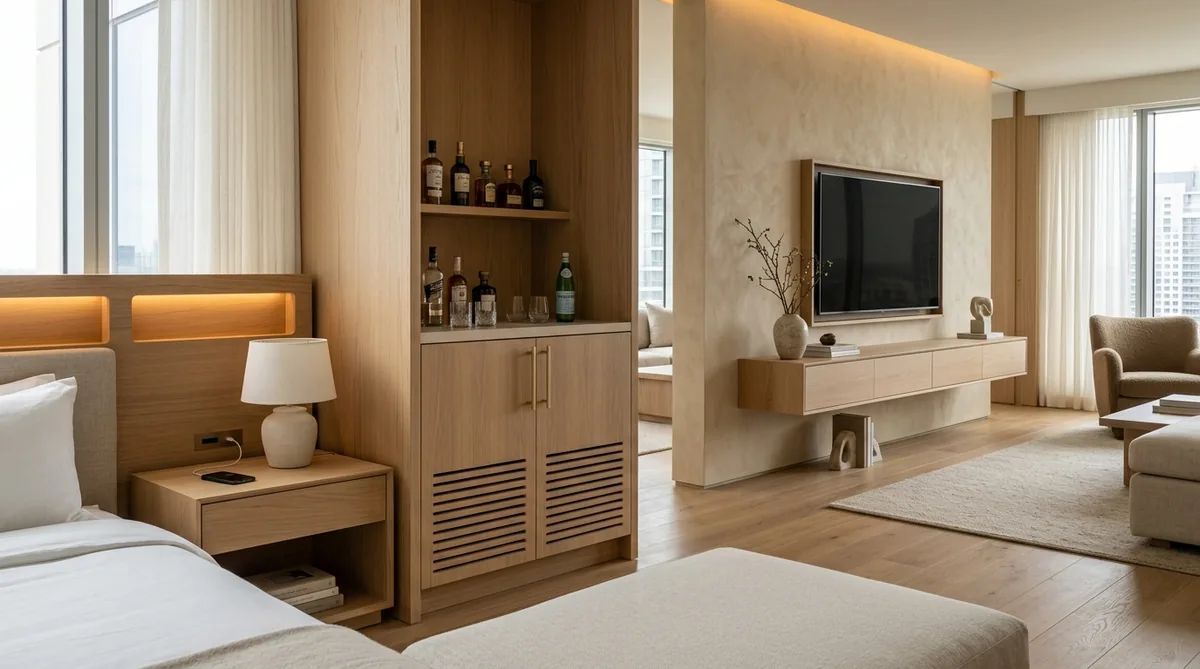
The decision that sets guestroom MEP-furniture coordination is made during shop drawing review, not on site: are the apertures cut in the factory to a drawing, or left to a jigsaw at handover. It does not move the bid number. It does decide whether replacing a faceplate in Year 6 takes three seconds or three hours, and whether the mini-bar cabinet settles at 32°C or climbs past 50°C. A furniture manufacturer does not run conduit, but aperture tolerance, chase depth, free vent area and access-panel location are all fixed by the furniture drawing — which is where the structural engineering of the casework meets Total Cost of Ownership (TCO).
In conventional hotel fit-outs, a lack of early-stage MEP-furniture coordination forces installation crews into crude, destructive on-site core drilling. This compromises factory edge-banding seals, triggers harmful formaldehyde and VOC emissions, damages electrical cable insulation, causes absorption mini-bars to overheat and fail, and creates maintenance deadlocks where entire millwork walls must be demolished to replace a simple transformer.
This technical guide deconstructs Sunder’s factory-prefabricated engineering standards across three critical guestroom zones: Headboard & Integrated Nightstands, Custom Mini-Bar Enclosures, and Cantilever Floating TV Media Consoles.
1. Four Failures That Surface in the First 12 to 36 Months
Engineering oversights at the MEP-furniture interface rapidly compound into substantial financial liabilities within the first 12 to 36 months of hotel operations:
+-------------------------------------------------------------------------+
|     4 Compounding Operational Failures from Uncoordinated MEP Interfaces |
+-------------------------------------------------------------------------+
|  1. Destructive On-Site Drilling  --> Board edge seal rupture, moisture |
|                                       swelling, 40% structural loss     |
|  2. Unprotected Cable Chases      --> Friction wear on wire insulation, |
|                                       ground faults & short circuits    |
|  3. Inadequate Mini-Bar Venting   --> Compressor thermal cutoff, 60%    |
|                                       power spike, premature failure    |
|  4. Permanently Sealed Millwork   --> Routine driver/socket replacement |
|                                       requires wall demolition          |
+-------------------------------------------------------------------------+- Precision Breakdown from Manual On-Site Core Cutting: Handheld jigsaw cutouts on job sites exhibit tolerances as wide as , causing socket faceplate misalignment, light leakage, chipping, and unsealed core exposure that accelerates moisture absorption.
- Sub-Optimal Cable Bend Radii: Forcing high-speed HDMI 2.1 cables, Cat.6A Ethernet, and high-voltage power lines around sharp wooden corners degrades data integrity and induces internal copper fatigue.
- Thermal Traps in Mini-Bar Enclosures: Silent absorption mini-bars generate continuous heat. Without engineered convective airflow, internal cabinet temperatures frequently exceed , at which point an absorption unit loses cooling capacity, draws more power, and the adhesive in the surrounding casework begins to soften.
- Destructive Maintenance Protocols: Embedding LED drivers and terminal blocks behind fixed wall panels turns a routine 10-minute component swap into a multi-hour construction intervention with irreparable surface scarring.
2. Headboard & Nightstand Engineering: 5-Axis CNC Milling, Flame-Retardant Grommets, and Magnetic Access
The guestroom bedside zone is the primary operational hub, concentrating master lighting switches, USB-C 65W PD fast charging, dimming controls, motorized drape actuators, and international power receptacles.
+-------------------------------------------------------------------------+
|         4-Layer Bedside MEP & Architectural Millwork Integration         |
+-------------------------------------------------------------------------+
|  [Layer 1: Decorative Facing]   High-durability natural veneer / HPL +  |
|                                 beveled brushed champagne metal trim    |
|                                |                                        |
|  [Layer 2: 5-Axis CNC Layer]    Factory pre-machined cutouts            |
|                                 (Tolerance <= +/- 0.5mm)                |
|                                |                                        |
|  [Layer 3: Wire Chase Channel]  Integrated flame-retardant conduit      |
|                                 (>= 45mm clear internal depth)          |
|                                |                                        |
|  [Layer 4: Quick-Release Core]  NdFeB magnetic latching modules         |
|                                 (Tool-free 3-second non-destructive)    |
+-------------------------------------------------------------------------+
1. 5-Axis CNC Precision Pre-Machining (Tolerance ≤ ±0.5 mm)
Sunder pre-mills 100% of faceplate apertures and cable pass-throughs in the factory prior to finishing. All internal cutout perimeter edges receive PUR (Polyurethane Reactive) waterproof hot-melt sealing or flame-retardant penetrating primers, eliminating moisture infiltration and VOC off-gassing.
2. Flame-Retardant Cable Grommets (UL94-V0 Rated)
Every timber penetration is fitted with factory-installed, UL94-V0 flame-retardant polyamide grommets with smooth elastomeric radiused lips, reducing insulation wear where the cable crosses a panel edge.
3. Magnetic Quick-Release Service Cavities (NdFeB Catches)
Concealed secondary cavities housing power supplies and smart control gateways utilize high-coercivity Neodymium (NdFeB) magnetic catches paired with precision guide dowels. Facility maintenance technicians can access internal wiring using a silicone suction cup in under 3 seconds without hand tools or structural damage, and the panel returns to flush alignment on the magnets.
3. Mini-Bar Enclosure Fluid Thermal Engineering: Chimney Effect Venting & Moisture Shielding
Hotel silent absorption refrigerators rely entirely on natural buoyancy-driven thermal convection across their rear heat-exchanger condenser coils. Obstructing this airflow raises condenser temperature until cooling capacity falls off.
              [Mini-Bar Cabinet Natural Convection Airflow Model]

                 Exhaust Air Venting via Top/Side Louvers (>= 100 cm²)
                                   ▲  ▲  ▲
                                   │  │  │
                        +──────────┴──┴──┴──────────+
                        │ ┌───────────────────────┐ │
                        │ │     [ Beverage Bar ]  │ │
                        │ ├───────────────────────┤ │
                        │ │                       │ │
                        │ │  [ Minibar Unit ]     │ │
        Chimney Effect  │ │                       │ │
        Airflow Channel │ │                       │ │ Rear Clearance >= 50mm
                        │ │ ┌───────────────────┐ │ │ (Aluminum Thermal
                        │ │ │ Condenser (Heat)  │ │ │  Reflective Shield)
                        │ │ └───────────────────┘ │ │
                        │ │                       │ │
                        │ └───────────────────────┘ │
                        +──────────┬──┬──┬──────────+
                                   ▲  ▲  ▲
                 Cool Air Intake via Recessed Plinth (>= 100 cm²)
1. Chimney Effect Fluid Dynamics Design
Sunder designs mini-bar cabinetry around an unobstructed two-way thermodynamic convection circuit:
- Bottom Air Intake: Concealed intake apertures integrated into the recessed plinth base providing a net free ventilation area .
- Rear Convection Chimney: A minimum continuous vertical clearance of between the refrigerator condenser and the millwork back panel.
- Top/Side Air Exhaust: Architectural horizontal louvered discharge slots positioned beneath the counter overhang with a net free area .
- Total Ventilation Index: A combined net airflow cross-section , maintaining internal cabinet ambient temperatures strictly below .
2. Thermal Radiation & Condensation Shielding
- Aerospace-Grade Aluminum Heat Shield: The internal rear cabinet wall is lined with pure aluminum radiant barrier foil, reflecting radiated heat away from delicate timber veneers.
- JIS F☆☆☆☆ Moisture-Resistant Substrates: All internal cabinetry utilizes high-density marine-grade multi-ply hardwood plywood conforming to Japanese Industrial Standard F☆☆☆☆, exhibiting a water-absorption thickness swelling rate to withstand defrost condensation.
4. Floating TV Consoles & Media Walls: Heavy-Duty Cantilever Steel Substructures and Vertical Cable Chases
Contemporary luxury guestrooms feature 65-inch to 75-inch hospitality displays paired with long-span floating TV consoles. Floating cabinetry must simultaneously resolve large-span bending stiffness and high-density cable concealment.
+-------------------------------------------------------------------------+
|         Floating TV Console Cantilever MEP & Structural Cross-Section   |
+-------------------------------------------------------------------------+
|  Reinforced Concrete / Structural Steel Wall                            |
|       │                                                                 |
|       ├── [High-Shear Chemical Anchors / Heavy-Duty M10 Expansion Bolts]|
|       │         │                                                       |
|       └── [Internal Cold-Rolled Steel Cantilever Bracket]               |
|           (40 x 40 x 3.0mm Galvanized Box Section)                      |
|                 │                                                       |
|                 ├── Concealed Ø 75mm Smooth Vertical Cable Chase Pipe   |
|                 │   (High/Low-Voltage Physical Separation)              |
|                 │                                                       |
|                 └── [Floating Console Body] (Uniform Load >= 150 kg,    |
|                           │                  Deflection <= 1.0mm)       |
|                           └── Flush Soft-Close Brush Grommet Lid        |
+-------------------------------------------------------------------------+
1. Embedded Cold-Rolled Cantilever Steel Frame
- Heavy-gauge hot-dip galvanized cold-rolled steel triangular cantilever brackets are pre-integrated within the console millwork and secured to structural walls using chemical anchors.
- Proof-loaded to a downward uniform distributed load of (preventing structural failure from guest seating loads), limiting leading-edge cantilever deflection to .
2. Dual-Chamber Ø 75mm Vertical Cable Chases
- A dedicated internal diameter smooth-bore vertical conduit connects the media wall display bracket to the lower console interior.
- Wide-radiused conduit mouths allow molded HDMI 2.1, DisplayPort, and regional power plugs to glide freely without snags or optical fiber micro-bending losses.
5. Total Cost of Ownership (TCO): Factory Prefabrication vs. On-Site Core Drilling
MEP-Furniture Integration: Factory Deepening vs. On-Site Core Cutting
| Evaluation Vector | On-Site Manual Drilling | Sunder Factory Prefab |
|---|---|---|
| Aperture Accuracy | Tolerance +/-5.0mm | 5-Axis CNC (+/-0.5mm) |
| Edge Sealing Quality | Raw exposed core, rot | Full PUR edge sealing |
| Mini-Bar Heat Dissip. | No airflow, > 50°C trap | Convective, <= 32°C |
| Single Circuit Repair | Demolish panel (2-4 hrs) | 3-sec magnetic access |
| Fit-Out Site Labor | +1.5 man-hours per room | Plug-and-play install |
| 10-Year Cumulative TCO | Baseline (100%) | Reduced to 35% (-65%) |
6. Conclusion: Concealing Technology in Luxury, Securing Asset Longevity
The parts of a guestroom nobody sees — cut edge sealing, chase depth, free vent area — set how many hours housekeeping and engineering spend on the same piece of furniture over ten years. Furniture is no longer an isolated decorative woodwork item; it is the physical housing, heat dissipator, and operational interface for intelligent guestroom electronics.
By embedding B2B Value Engineering (VE) and rigorous factory pre-fabrication into early design phases, Sunder engineers nightstand cable routings, mini-bar convection aerodynamics, and cantilever console load mechanics directly into production lines. This scope has a boundary worth naming: it covers apertures, chases and ventilation inside the furniture itself, not in-wall conduit, circuit capacity or low-voltage system design, which stay with the MEP consultant and contractor. At drawing review, confirm that the furniture and MEP drawings share one datum for aperture coordinates.