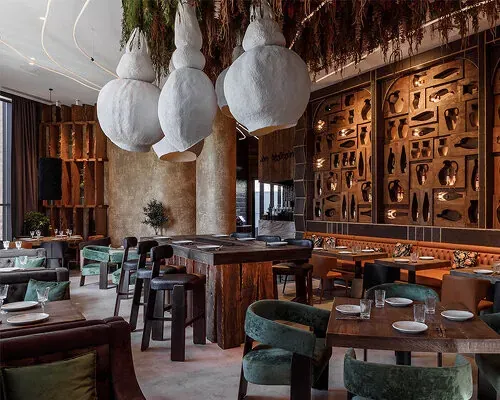
Executive Summary
Technical guide addressing wood stability, gold plaster coating, and structural lighting in hospitality FF&E engineering.
Spatial Philosophy & Architectural Narrative
The spatial philosophy translates Georgian regional heritage into modern hospitality environments. Incorporating elements like peppercorn balusters, beehive lighting fixtures, solid tree-trunk dining tables, and gilded plaster surfaces, the project constructs a layered architectural narrative. Spatial zoning utilizes varied ceiling heights and controlled circulation paths to optimize guest flow and visual engagement. Lighting strategy employs 2700K low-glare warm illumination, specifically calibrated to accentuate raw timber textures and metallic plaster sheens. From a commercial real estate perspective, cultural motifs must be engineered for operational durability and structural stability. Overhead feature lighting and intricate partition balusters require stringent load distribution analysis and maintenance access planning, ensuring the installation maintains aesthetic integrity throughout high-volume food and beverage service.
Luxury FF&E Material Engineering & Joinery Breakdown
For solid tree-trunk tables and architectural joinery, substrates specify F1 grade moisture-resistant low-formaldehyde plywood paired with kiln-dried hardwoods, maintaining equilibrium moisture content between 8% and 10%. To counteract internal tensile stress in large-section timber, embedded steel core reinforcement rods and stress-relief expansion channels are integrated into mortise-and-tenon joints, successfully preventing structural warping or dimensional checking.
The gilded plaster surface implementation requires a precision multi-layer system: a sealer moisture barrier primer, followed by a high-density micro-cement base, hand-applied 24K leaf or metallized polyurethane coating, and capped with a two-component clear aliphatic polyurethane topcoat. This coating system complies with ASTM D3359 cross-hatch adhesion standard at Class 5B and ASTM D4060 Taber abrasion resistance (CS-10 wheel, 1000g load, < 0.03g weight loss after 1000 cycles), providing chemical resistance against food acids and industrial cleaning solvents.
Custom beehive lighting fixtures and peppercorn baluster hardware utilize SUS304 stainless steel with PVD titanium vapor deposition and precision-machined brass components. All structural welds undergo continuous TIG welding and flush grinding. The PVD coating thickness measures >= 0.3 μm, passing ASTM B117 96-hour neutral salt spray corrosion testing. Material transition joints between metal, timber, and stone accommodate a 1.5 mm to 2.0 mm expansion gap, sealed with high-modulus neutral silicone sealant.
Upholstery textiles satisfy BS 7176 Medium Hazard (Crib 5 flaming ignition source test) flammability rating and exceed 50,000 cycles on the Martindale abrasion test. Natural stone surfaces feature a rear-laminated 300g/m² fiberglass mesh bonded with structural epoxy resin, completed with a fluorocarbon penetrating sealer achieving a water contact angle > 105 degrees.
Hospitality Operations, Wear Analysis & TCO Model
High-traffic commercial F&B environments induce accelerated wear across millwork edges, seating bases, and balustrade structures. Traditional site-applied finish systems typically require localized refinishing within 18 to 24 months due to mechanical impacts and spill degradation, directly elevating CapEx and operational downtime.
Implementing factory-applied PVD stainless steel trimming, high-solids polyurethane coatings, and internal steel chassis reinforcement extends furniture service lifecycle from 3 to over 7 years. Financial modeling for a 100-seat premium restaurant demonstrates that a 12% upfront investment in advanced material engineering yields a 35% reduction in cumulative maintenance and replacement expenditures over a 5-year operating horizon.
Operational maintenance protocol mandates semi-annual torque verification on metal connector bolts (12–15 Nm standard) and annual re-application of stone sealants and wood surface protective wax. This systematic preventive approach minimizes Total Cost of Ownership (TCO) while enhancing Net Operating Income (NOI).
Sunder Engineering Grounding & Subtropical Climate Defense
Subtropical island climates, characterized by ambient relative humidity levels between 75% and 85%, present severe moisture expansion and mold challenges for millwork installation. Factory fabrication requires strict environmental controls, stabilizing timber equilibrium moisture content strictly between 8% and 12%.
Prior to factory dispatch, all millwork components—including unexposed rear panels and cut edges—must receive a two-component polyurethane sealing coat to eliminate moisture ingress. Mortise-and-tenon connections integrate a 0.8 mm stress-relief tolerance gap and utilize polyurethane (PUR) reactive adhesives for maximum bond durability.
Utilizing modular off-site fabrication, complex ceiling feature elements, wall-mounted gold plaster panels, and built-in banquettes are pre-assembled and pre-finished up to 95% under factory conditions. Field execution relies solely on dry mechanical anchoring system, reducing site installation time by 30% and eliminating moisture-induced warping during fit-out.
B2B Material & Inspection Specification Table
The following specification table outlines quantitative acceptance criteria for quality control and procurement verification.
| Component | Specification | Inspection Standard | Tolerance & Criteria |
|---|---|---|---|
| Solid Timber & Millwork | F1 moisture-resistant plywood, internal steel core, moisture content 8-12% | ISO 12572 / CNS 1349 | Moisture ±1.0%, Diagonal tolerance ≤ 0.5 mm |
| Gold Plaster Surface | Micro-cement base, dual sealer, transparent PU topcoat | ASTM D3359 / ASTM D4060 | Adhesion Class 5B, Wear loss < 0.03g / 1000 cycles |
| PVD Titanium Trim | SUS304 stainless steel, PVD coating thickness ≥ 0.3 μm | ASTM B117 Salt Spray | 96 hours zero corrosion, Color variance ΔE < 0.5 |
| Fire-Retardant Fabric | BS 7176 Medium Hazard compliant, high-durability weave | BS 7176 / ISO 12947-2 | Crib 5 passed, Martindale ≥ 50,000 cycles |
Site inspection protocol requires pin-type moisture meter calibration for timber components, alongside spectrophotometer color difference verification across all PVD metallic batches.