Executive Summary
Engineering 1930s-inspired hotel FF&E prototypes into durable hospitality assets with high fabric specs and TCO defense.
Spatial Philosophy & Architectural Narrative
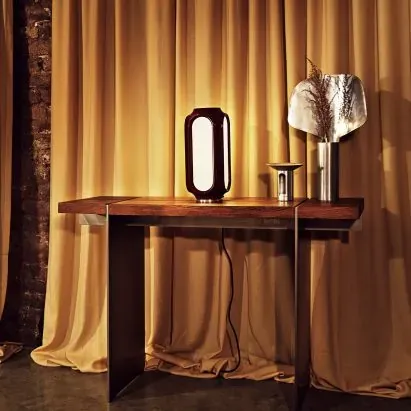
Inspired by 1930s elegance, the Collate Lobby exhibition presents a fictional hotel suite and foyer that translates period aesthetics into contemporary commercial hospitality spaces. Implementing this design narrative requires precise coordination between fixed joinery and lighting integration. The 1930s aesthetic relies heavily on geometric symmetry, streamlined curves, and metallic accents. In modern hospitality environments, these components must seamlessly align with operational circulation and high-density guest interactions. Lighting design incorporates indirect 2700K-3000K LED illumination, interacting with matte veneers and metallic trims to create layered visual depth and elevate brand recognition. From a commercial asset perspective, loose and fixed furniture items are key touchpoints that directly shape guest perceptions, making functional durability and aesthetic balance crucial for long-term operational returns.
Luxury FF&E Material Engineering & Joinery Breakdown
Converting 1930s prototype concepts into commercial hospitality FF&E demands rigorous engineering specifications. Substrates for fixed joinery utilize F1 grade low-formaldehyde moisture-resistant plywood with formaldehyde emissions <= 0.3 mg/L and thickness swelling rate <= 3.0%. Surface finishes feature 0.6 mm natural hardwood veneers bonded with PUR hot-melt adhesives, achieving edge peel strength >= 1.2 N/mm. Hardware systems incorporate heavy-duty concealed slides and 3D adjustable hinges rated for 100,000 operational cycles under a 45 kg dynamic payload, with joint deflection restricted within 0.5 mm. Metallic accents feature AISI 304 stainless steel coated with PVD titanium film at 0.3-0.5 micron thickness, passing a 96-hour neutral salt spray test without oxidation. Natural stone tabletops integrate a 3 mm aluminum honeycomb backing paired with epoxy glass fiber matrix to reduce dead weight and increase flexural strength threefold. Upholstery fabrics meet a minimum Martindale abrasion resistance of 45,000 cycles and comply strictly with BS 7176 Medium Hazard (Crib 5) fire safety codes, featuring integrated stain-resistant hydrophobic treatments.
Hospitality Operations, Wear Analysis & TCO Model
High-frequency wear on hospitality FF&E directly inflates operating expenses and reduces Room Revenue per Available Room (RevPAR). Luggage benches, desk edges, wardrobe handles, and armchair armrests represent high-impact points vulnerable to damage within 24 months if standard residential finishes are used. Total Cost of Ownership (TCO) evaluation follows the framework: TCO = Initial CapEx + Maintenance OpEx + Downtime Loss - Residual Asset Value. Implementing factory-applied 2K polyurethane coatings (surface hardness 2H, abrasion resistance <= 20 mg/1000 cycles) alongside 1.0 mm radiused metallic edge protection extends minor touch-up intervals from 2 to 5 years and postpones major soft refurbishment to a 10-year cycle. Financial modeling demonstrates that a 12% increase in initial FF&E engineering standards reduces room downtime caused by FF&E defects by 65%, achieving a net 22% reduction in lifecycle cost over a 7-year operational horizon.
Sunder Engineering Grounding & Subtropical Climate Defense
Deploying 1930s design hospitality furniture in subtropical and island environments (where relative humidity averages 75-85%) requires specialized climate adaptation. Moisture content (MC) of all solid wood and substrate panels must be stabilized between 8-12% during manufacturing. Non-visible backing panels receive a double-sided polyurethane moisture barrier coating to prevent ambient vapor absorption. Structural designs incorporate 1.5 mm expansion joints and concealed floating cleats to accommodate thermal and moisture-induced dimensional changes. Adopting a modular pre-fabrication model allows 95% of joinery machining, dry-fitting, and inspection to occur inside controlled factory facilities. On-site installation is limited to modular mounting, reducing installation timelines by 35% and mitigating humidity damage risks during fit-out.
B2B Material & Inspection Specification Table
To ensure strict quality control during B2B procurement, the table below outlines specifications, testing standards, and tolerance criteria for key 1930s-style FF&E components:
| Component | Specification | Inspection Standard | Tolerance & Criteria |
|---|---|---|---|
| Fixed Joinery Substrate | F1 moisture-resistant plywood, dual sealed | CNS 1349 / ISO 12460 | Formaldehyde <= 0.3 mg/L, Swelling <= 3% |
| Metal Trims | AISI 304 Stainless Steel, PVD Titanium | ASTM B117 Salt Spray | PVD Thickness 0.3-0.5 um, 96h Corrosion-free |
| Cabinet Hardware | Heavy-duty soft-close slides & hinges | DIN EN 15338 | 45 kg Load, 100,000 Cycles, Deflection <= 0.5 mm |
| Upholstery Fabric | Fire-retardant dense weave with stain barrier | BS 7176 / ISO 12947 | Martindale >= 45,000 cycles, BS 7176 Crib 5 |
| Stone Countertops | Natural Marble + 3 mm Aluminum Honeycomb | ASTM C99 Flexural | Flatness Tolerance <= 0.5 mm/m |
All components must be verified against mill test reports and third-party laboratory certifications prior to installation.