Executive Summary
Technical specifications for commercial-grade metal armchairs, optimizing durability and TCO in high-traffic hotels.
Spatial Philosophy & Architectural Narrative
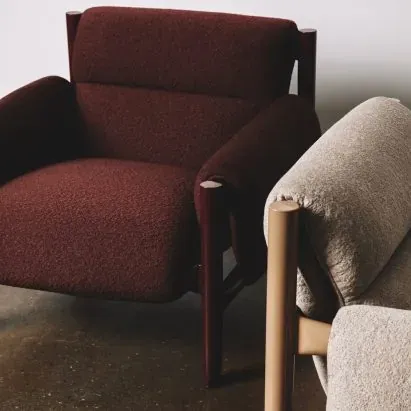
Modern hospitality spatial design increasingly emphasizes the integration of structural honesty and regional narratives. Translating rugged agricultural fence framing into refined hotel furniture requires balancing industrial weight with spatial linear clarity. In high-traffic lounge and guestroom zones, these metal-framed armchairs act as lightweight visual anchors. The exposed metal tubing creates geometric silhouettes and shadows that interact dynamically with natural light, reducing the visual bulk typical of traditional fully upholstered seating. When positioned on marble flooring against warm wood paneling, this design establishes a material contrast. Through precise proportioning, the rigidity of the metal chassis and the tactile softness of the upholstery achieve sensory equilibrium. This balance meets the contemporary traveler’s preference for visual purity while embedding a quiet yet powerful brand narrative within the structural geometry of the space.
Luxury FF&E Material Engineering & Joinery Breakdown
The structural integrity and surface finishing of commercial-grade metal armchairs dictate their operational lifespan in high-traffic hotel environments. The chassis utilizes cold-rolled SUS 304 stainless steel tubing with a minimum wall thickness of 2.0 mm to prevent structural deformation under continuous load. All joint connections must undergo full penetration welding, ground flush, and polished to a seamless tolerance of ±0.1 mm. The frame is then finished with physical vapor deposition (PVD) titanium coating, producing a surface hardness exceeding HV 2000 with anti-fingerprint properties to withstand impacts from luggage and vacuum cleaners. For the upholstered seat pan, the inner substrate utilizes 18 mm thick F1-grade low-formaldehyde moisture-resistant multi-layer plywood rather than plastic injection shells. This plywood is CNC-milled with ventilation apertures. The cushioning layer consists of high-resiliency polyurethane foam with a minimum density of 45 kg/m³, supported by a suspension network of S-springs and high-tensile elastomeric webbing. This assembly ensures that the residual deformation remains below 5% after a 100,000-cycle dynamic load test. Upholstery fabric must exceed 40,000 Martindale rubs without yarn breakage, treated with water-and-stain-repellent finishes. Fire safety compliance requires the complete upholstery assembly to meet BS 7176 Medium Hazard (Crib 5) standards. To prevent squeaking and loosening over time, all connections between the metal frame and the wooden seat pan must utilize M6 threaded steel inserts (T-nuts) and grade 8.8 carbon steel bolts equipped with split-lock washers and nylon isolation gaskets.
Hospitality Operations, Wear Analysis & TCO Model
From a hospitality asset management perspective, initial CapEx for public area and guestroom furniture represents only 40% of its Total Cost of Ownership (TCO). The remaining 60% is dictated by maintenance, repairs, and premature replacement. High-frequency wear points on armchairs typically concentrate on the lower legs (impact from cleaning machinery), the front armrests (acidic degradation from skin contact), and the seat edge (shear stress from user loading). To mitigate these operational risks, the proposed TCO defense model integrates high-density polyethylene (HDPE) glide inserts on the feet to isolate vibration and protect flooring. By specifying a modular seat and back assembly, properties can replace a damaged cushion in under 15 minutes in-situ. This eliminates out-of-service room losses and off-site repair costs. Financial projections indicate that upgrading to 40,000 Martindale rub fabrics and PVD coatings extends the furniture lifecycle from 3.5 to 7 years. This reduces annualized depreciation expenses by 45%, significantly optimizing medium-term CapEx while ensuring consistent aesthetic standards across the asset’s lifecycle.
Sunder Engineering Grounding & Subtropical Climate Defense
The high-temperature, highly humid subtropical climate of the Asia-Pacific region (with relative humidity averaging 75-85%) presents a severe test for hybrid metal-wood furniture. During factory fabrication, microclimate control is imperative. All timber and plywood substrates must undergo a secondary kiln-drying process, stabilizing moisture content strictly within the 8% to 12% equilibrium range. To prevent moisture ingress, all concealed wood surfaces, including backboards and undersides, must receive double-sided sealing. This process requires three coats of moisture-resistant primer and one coat of protective polyurethane topcoat to block moisture absorption and avoid delamination or warping. Furthermore, since stainless steel and wood possess highly divergent thermal expansion coefficients, connection points must be engineered with a 1.5 mm physical expansion allowance. EPDM rubber isolation washers must be installed at these interfaces to absorb sheer stress, preventing timber splitting and maintaining structural alignment under fluctuating humidity levels.
B2B Material & Inspection Specification Table
Procurement and inspection guidance: 5% of delivered batches must be randomly selected for load-bearing and pulling tests. Metal surfaces must undergo a cross-cut tape test (ASTM D3359) to confirm an adhesion rating of 5B.
| Component | Specification | Inspection Standard | Tolerance & Criteria |
|---|---|---|---|
| Metal Chassis | SUS 304 stainless steel tubing, t >= 2.0mm, PVD coated | ASTM A276 / ASTM B117 | Weld joint tolerance <= 0.1mm; Salt spray test 96h without corrosion |
| Cushion Substrate | 18mm F1 plywood + 45 kg/m³ HR polyurethane foam | EN 717 / ASTM D3574 | Formaldehyde emission <= 0.5 mg/L; Resilience rate >= 45% |
| Upholstery Fabric | Heavy duty hospitality fabric with hydrophobic finish | ISO 12947-2 / BS 7176 | Martindale rubs >= 40,000; Compliant with BS 7176 Medium Hazard |
| Fastening Hardware | M6 threaded inserts, grade 8.8 bolts, nylon washers | ISO 898-1 | 100,000 cyclic fatigue tests without loosening or noise |