Executive Summary
Optimizing acoustic dining spaces against moisture and wear using durable F1-grade joinery to lower long-term CapEx.
Spatial Philosophy & Architectural Narrative
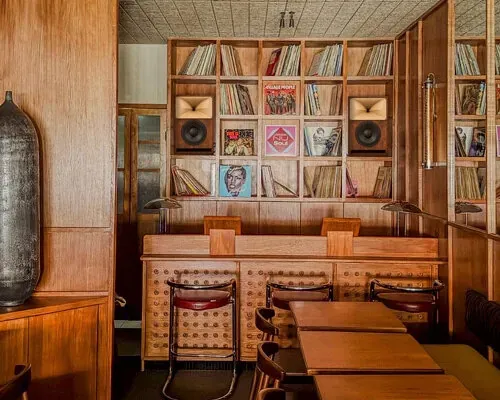
The physical interface of commercial dining spaces serves as an extension of brand sensory identity. In the case of the Paris SOBO listening restaurant, the interior architecture merges high-fidelity analog acoustics with premium hospitality. By aligning spatial hierarchy with sound engineering, the design utilizes structural oak framing and integrated acoustic panels to regulate sound reflection, maintaining the reverberation time (RT60) within 0.6 seconds. Warm 2700K indirect lighting interacts with the deep-toned oak veneer, reducing visual fatigue and establishing intimate pockets of space. This layout successfully mitigates the common hospitality pain point of high-frequency background noise generated by hard-surface reverberations, which often disrupts high-end dining experiences. The integration of mid-century vintage furniture with newly fabricated oak joinery creates a balanced aesthetic tension. By prioritizing acoustic physics, low-glare illumination, and acoustic absorption, the design converts a standard dining layout into an immersive listening lounge. This approach establishes a clear sensory benchmark that enhances brand equity and asset value in upscale hospitality real estate, showing how bespoke architectural millwork serves both acoustic and structural purposes.
Luxury FF&E Material Engineering & Joinery Breakdown
The technical value of high-end commercial FF&E and bespoke joinery lies in the integration of structural integrity, environmental compliance, and material durability. For projects utilizing extensive oak finishes, engineering practice dictates the use of F1-grade moisture-resistant plywood as the core substrate, adhering to low formaldehyde emission standards (average release below 0.3mg/L) to prevent board deformation and delamination under fluctuating indoor temperatures. Wood veneer cladding must utilize natural timber veneers with a minimum thickness of 0.6mm, book-matched and applied using a DIN EN 204 D3 waterproof two-part polyurethane adhesive. This prevents surface bubbling and peeling when subjected to high-temperature food service. For metal trimming and protective edge banding, the design should incorporate SUS 304 stainless steel treated with PVD titanium coating. This deposition layer (minimum thickness 1.5 microns) raises surface hardness to over HV 800, protecting the metal trim from high-frequency abrasion and acidic cleaning agents. Edge banding of the wood panels must be processed using hot-melt polyurethane (PUR) technology instead of conventional EVA glues. PUR edge banding offers superior resistance to water penetration and thermal stresses up to 150 degrees Celsius, ensuring the joints remain sealed against liquid spills. The final surface coat should consist of a multi-layer polyurethane topcoat finishing with UV inhibitors to prevent wood discoloration caused by sunlight exposure. Where natural stone meets wood framing, structural crack prevention is paramount. Every natural marble or quartz countertop must be reinforced with a high-strength unsaturated polyester resin mesh backing. Furthermore, a 2mm expansion gap filled with high-elasticity neutral silicone must be detailed at the wood-to-stone joint to absorb structural shifting and localized load impacts. For upholstered seating and banquettes, fabric durability and fire retardancy are critical to managing operational liabilities. Selected textiles must exceed a Martindale abrasion resistance rating of 40,000 rubs without fiber breakage. Additionally, the complete upholstery assembly must comply with BS 7176 Medium Hazard (Crib 5) fire safety regulations. The internal high-density polyurethane foam (minimum density 45kg/m³) should be treated with non-halogenated flame retardants, ensuring a rapid carbon-char barrier forms upon ignition to limit heat release and smoke density. Finally, movable components, including drawer slides and door hinges, must feature integrated dampers certified under DIN EN 15570 Level 3 (tested for 80,000 heavy-load cycles under a 40kg load limit), ensuring the operational longevity required in five-star hospitality spaces and preventing premature door sagging.
Hospitality Operations, Wear Analysis & TCO Model
Hospitality asset management focuses on balancing initial Capital Expenditure (CapEx) against the lifetime Total Cost of Ownership (TCO). In high-traffic dining environments, key wear points include chair bases, booth frames, and serving counter corners. Implementing consumer-grade FF&E (e.g., 15,000-rub fabrics, standard MDF, and basic hardware) results in structural failures, sagging foam, and delaminated veneers within 24 to 36 months, leading to frequent maintenance and lost revenue due to seat downtime. A robust asset depreciation model evaluates costs using the TCO formula: TCO = C_initial + (C_maintenance * L) - C_residual, where C_initial represents the procurement cost, C_maintenance the annual upkeep cost, L the operational lifespan, and C_residual the salvage value. Specifying contract-grade dining furniture—featuring high-resilience foam, SUS 304 protective kickplates, and 40,000-rub stain-resistant textiles—increases upfront procurement costs by approximately 30%. However, this specification extends the maintenance interval from 18 months to 60 months. Over a 10-year operational lifecycle, low-spec furniture typically requires 2.5 full replacement cycles. Each replacement cycle incurs indirect costs from operational downtime. In contrast, engineered FF&E only requires minor on-site topcoat finishing and touch-ups around Year 5. Financial analysis shows that investing in engineered FF&E specifications reduces 10-year TCO by over 35%, ensuring consistent brand presentation while stabilizing the property’s long-term operational cash flow.
Sunder Engineering Grounding & Subtropical Climate Defense
Adapting oak-centric designs to the subtropical climates of the Asia-Pacific region, where relative humidity levels average 75-85%, requires rigorous environmental defense engineering. Controlling the Equilibrium Moisture Content (EMC) is critical to preventing wood warping, splitting, and joint failure. Before production, all raw oak and timber substrates must undergo kiln drying and high-frequency conditioning to stabilize moisture content between 8% and 12%. To prevent structural imbalances, a double-sided moisture barrier seal must be applied. Manufacturing practices must avoid the common cost-cutting error of finishing only visible surfaces. If the back of a panel remains unsealed, uneven moisture absorption will cause severe bowing. Therefore, all unexposed panels and cut edges must receive a dedicated moisture barrier primer prior to leaving the factory. Additionally, large millwork assemblies should feature floating joinery with pre-inserted metal fasteners, leaving a 1.5mm tolerance gap to accommodate natural timber expansion and contraction. Implementing a factory-prefabricated modular strategy is recommended. By completing 90% of cutting, edge banding, and topcoat finishing in a temperature-controlled factory environment, on-site installation time can be reduced by 40%. This method protects raw wood from damp construction sites, guaranteeing superior paint film adhesion and preventing surface blushing.
B2B Material & Inspection Specification Table
To assist B2B procurement managers and site supervisors in maintaining quality control, the following table details the key material specifications and acceptance tolerances for contract-grade millwork and upholstery:
| Component | Specification | Inspection Standard | Tolerance & Criteria |
|---|---|---|---|
| Wood Substrate | F1-grade moisture-resistant plywood, 8-12% EMC | CNS 1349 / ISO 12460 | Formaldehyde ≤ 0.3 mg/L, thickness swelling ≤ 5% |
| Oak Veneer | 0.6mm natural oak veneer, PUR edge banding | DIN EN 204 D3 | No bubbling, diagonal alignment tolerance ≤ ±0.5 mm |
| Hardware & Hinges | SUS 304 soft-close hinges, load capacity ≥ 40kg | DIN EN 15570 Level 3 | 80,000-cycle fatigue test, sagging tolerance ≤ 0.5 mm |
| Metal Trims | SUS 304 stainless steel, PVD titanium finish | ASTM A240 / HV 800 | Coating thickness ≥ 1.5 μm, joint mismatch ≤ 0.2 mm |
| Seat Upholstery | Heavy-duty woven fabric, high-density FR foam | Martindale / BS 7176 | Abrasion resistance ≥ 40,000 rubs, passes Crib 5 |
During inspection, use a pin-type moisture meter to verify wood EMC, and feeler gauges to verify metal-to-stone alignments. All active hardware must be tested manually to ensure smooth damper motion without any structural scraping.