Executive Summary
Analysis of modular UHPC furniture engineering, detailing moisture barrier standards and lifecycle cost optimization.
Spatial Philosophy & Architectural Narrative
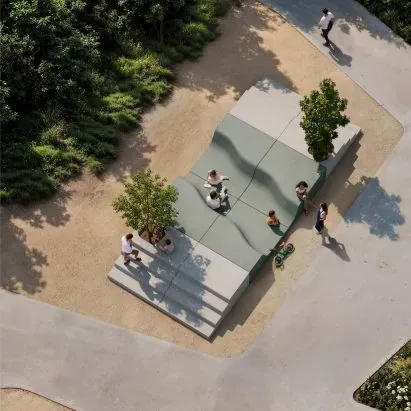
The engineering implementation of the modular concrete system focuses on deconstructing commercial and luxury hospitality transitional spaces. Inspired by modular step-and-slope geometry, these elements eliminate physical boundaries imposed by conventional outdoor fixtures. By calculating macro-wind patterns and solar angles, the layout optimizes natural shading and pedestrian flow. During daylight, the micro-porosity of Ultra-High Performance Concrete (UHPC) captures light at a 45-degree angle, echoing the building’s facade geometry. This modular topography guides high-occupancy circulation while providing functional rest zones. It merges landscape architecture with commercial FF&E, allowing operators to reconfigure outdoor spatial assets dynamically without costly structural alterations. The system functions as a dynamic landscape divider, replacing rigid masonry walls with soft transitions. Engineers can curate paths that steer pedestrian velocity, slowing down foot traffic near entry thresholds while accelerating flow along high-exposure retail storefronts.
Luxury FF&E Material Engineering & Joinery Breakdown
To execute this modular concrete design in luxury hospitality environments, the engineering focus shifts to raw material mechanics and environmental resilience. The primary material utilizes Ultra-High Performance Concrete (UHPC) achieving a compressive strength exceeding 120 MPa and a flexural strength of at least 15 MPa. To prevent micro-cracking and improve impact resistance, the matrix is reinforced with 2% volume fraction of rust-resistant stainless-steel fibers or alkali-resistant glass fibers (AR-Glass). Integral coloration using UV-stable inorganic metal oxide pigments is applied during dry-mixing to prevent discoloration caused by severe weathering. For structural joinery, the modules are anchored horizontally using recessed Grade 316 stainless steel sleeve bolt assemblies. EPDM rubber dampening gaskets (Shore A 70) are positioned at the interfaces to absorb thermal expansion stresses and prevent micro-frictional chipping. All sharp edges are chamfered to an R10 mm - R15 mm profile and diamond-polished using 800 to 1200 grit pads. Where timber elements interface with the concrete, kiln-dried Burmese Teak or Grade A thermally modified southern pine is specified, with moisture content stabilized at 10% ± 2%. These wood components are secured using blind mortise-and-tenon joints to eliminate surface fasteners, avoiding rust weeping. Any accompanying outdoor upholstery must utilize solution-dyed acrylic fabrics with a Martindale abrasion resistance rating of 40,000+ rubs. Upholstery must meet BS 7176 Medium Hazard (Crib 5) fire retardancy standards and achieve ISO 846 Class A mold-resistance rating. Internal structural steel frames undergo hot-dip galvanizing followed by polyester powder coating, passing a 1,000-hour salt spray test (ASTM B117) to withstand aggressive atmospheric conditions.
Hospitality Operations, Wear Analysis & TCO Model
From an asset management perspective, outdoor commercial furniture is vulnerable to chemical staining, impact loading, and environmental degradation, driving high OpEx. While traditional glass fiber reinforced concrete (GFRC) exhibits micro-cracking within 3-5 years, the engineered UHPC modules feature a water absorption rate under 1% (ASTM C642), preventing coffee, acid rain, and organic oil penetration. A 10-year Total Cost of Ownership (TCO) financial model reveals that although initial CapEx for custom mold fabrication and UHPC casting is 40% higher than standard concrete alternatives, the operational lifespan exceeds 15 years. The scheduled maintenance cycle is extended from annual wood refinishing to a 5-year hydrophobic nano-sealer application, reducing OpEx by 75%. Crucially, the modular configuration allows individual units to be hoisted and replaced without shutting down entire hospitality plazas, ensuring operational continuity and protecting the yield per square meter.
Sunder Engineering Grounding & Subtropical Climate Defense
Addressing the subtropical, high-salinity island climate of the Asia-Pacific region—where relative humidity routinely fluctuates between 75% and 85%—requires systematic factory production protocols. Concrete pouring must occur in temperature-controlled facilities using high-frequency vibrating tables to eliminate air pockets, restricting overall porosity to below 1.5%. Curing proceeds in a two-stage process: 24-hour accelerated steam curing at 60°C, followed by a 28-day water-immersion curing cycle to guarantee complete hydration. Before leaving the factory, all units receive a dual-coat, double-sided hydrophobic nano-impregnation treatment to form an active moisture barrier. This prevents salt-laden air from penetrating and oxidizing internal fiber reinforcements. Additionally, structural joint tolerances between adjacent modules are engineered at 5 mm to 8 mm to accommodate seismic displacement and differential settlement, avoiding localized stress concentration and surface cracking.
B2B Material & Inspection Specification Table
To guarantee strict compliance during site procurement and handover, all modular installations must be cross-referenced with quantified parameters. Quality control inspects surface deviation, joint alignment, and sealer adhesion within 48 hours post-installation.
| Component | Specification | Inspection Standard | Tolerance & Criteria |
|---|---|---|---|
| UHPC Core Body | 120+ MPa compressive strength concrete with 2% SS fibers | ASTM C39 / ASTM C1609 | Surface flatness deviation ≤ 1.5 mm |
| Interface Gasket | EPDM rubber (Shore A 70), UV and weathering resistant | ASTM D2240 | Thickness tolerance ±0.5 mm, zero compression set |
| Structural Fasteners | Grade 316 stainless steel, recessed expansion sleeves | ASTM A276 / ASTM B117 | No visible red rust after 1000-hr salt spray |
| Moisture Sealant | Dual-layer hydrophobic nano-fluorosilane sealer | ASTM 514 / EN 1504-2 | Water absorption reduced by > 90%, UV stable |